Why 1064 nm Became the Industrial Standard for Metal Marking
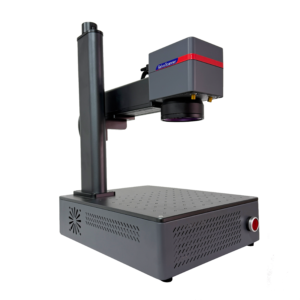
The 1064 nm fiber laser became the default tool for industrial marking for one reason: it is the wavelength that metals absorb most efficiently. The beam is generated in a fiber source (Raycus, Max or JPT), delivered through a flexible optical fiber to the galvo head, and focused by an F-theta lens to a 30–50 µm spot. Unlike a CO₂ laser (10.6 µm), which reflects off bare metal, or UV (355 nm), which works by photochemical bond breaking, 1064 nm heats the metal surface because free electrons absorb the photon energy. That is why one wavelength handles stainless steel, carbon steel, aluminum, brass, copper, titanium and precious-metal alloys equally well. Marking needs no consumables, draws <0.5 kW from a 220 V/50 Hz supply, and the source is rated for 100,000 hours. On LAMBD equipment — T6 Mini 5–20 W, LM-11-3 20–30 W, LM-1-x MOPA 20–100 W and LM-9-2 50–100 W — this delivers ±0.001 mm repeatability, a 0.01 mm minimum line width and galvo speed up to 7000 mm/s. For an English-site reader the key idea is simple: 1064 nm is not “stronger,” it is better matched to metal, and that match is why fiber is the best-selling laser class in the world.
How a Mark Is Formed: Absorption, Melting and Oxidation
A 1064 nm mark is produced by three distinct physical mechanisms, and knowing the difference is what separates a clean code from a failed one. First, oxidation (annealing). At moderate energy density the surface is heated to the temperature where an oxide film forms, but does not melt; no metal is removed, and the color comes from oxide thickness. This is how dark and colored codes are made on stainless steel and titanium without material removal — the required method for medical instruments and thickness-critical parts. Second, melting and swelling. At higher energy the surface melts locally and, on cooling, forms a micro-relief that scatters light, so the code appears bright and matte. Third, ablation. At high energy density the material vaporizes and is ejected, leaving a deep track — deep engraving, which the LM-9-2 50–100 W performs up to 1.0 mm in steel and titanium. The switch between modes is set by three parameters: power percentage, pulse repetition rate (20–4000 kHz) and scan speed (300–8000 mm/s), while pass count sets the depth. LAMBD builds recipes so that each job uses the least aggressive mode that works: oxide for a serial number, melting for a readable logo, ablation for a stamp or deep engraving.
Stainless Steel: Black Anneal, White and Color Marks
Stainless steel is the most rewarding material for a fiber laser because it holds a stable, corrosion-resistant and readable code. The baseline recipe for a dark anneal on an LM-11-3 30 W is 40–70% power, 20–50 kHz, 300–800 mm/s, 1–2 passes. On the LM-1-5 MOPA 20–30 W, the same result comes at lower average power thanks to a short pulse, which reduces the heat load on the part. A white mark on stainless is made either by melting at 60–90% power, 20–30 kHz, 200–500 mm/s, or by multiple low-energy passes that build a matte relief without darkening. Color marking is a separate discipline: oxide thickness can only be controlled in nanometers by a MOPA source with adjustable pulse width <10 ns–~200 ns, and on steel this yields stable hues from straw to blue. Grade matters. AISI 304 holds color and black anneal predictably; AISI 316 needs slightly more energy because of its molybdenum; AISI 430 (ferritic) may give a duller contrast. Always test on an offcut of the same sheet, because mill finish, Scotch-Brite brushing, mirror polish and passivation all change absorption. For medical and food equipment, LAMBD recommends the oxide mode with no material removal, plus a mandatory ISO/IEC 15415 check after reading.
Aluminum: A Reflective Surface and a Thin Native Oxide
Aluminum is the hardest of the three base metals because it reflects up to 90% of 1064 nm radiation and instantly grows its own oxide film. On bare 6061 or 1050 aluminum the starting recipe is 30–60% power, 20–40 kHz, 400–900 mm/s, 1–2 passes; the mark comes out light because the laser creates a micro-relief in the oxide rather than changing the metal color. For a dark, high-contrast code, use a multi-pass regime with lower energy per pass — the surface darkens without deep removal. Anodized aluminum behaves differently: the laser burns the dye out of the anodic layer and exposes the light substrate, so a white mark needs only 20–50% power, 30–80 kHz, 500–1200 mm/s, 1 pass. Color marking on anodized aluminum is where LM-1-x MOPA excels: vary pulse width and frequency and you get a palette from black to gold, green and blue — with no paint or lacquer. Two rules are mandatory. First, never mark through a protective film or oil film: a melted film leaves a dirty edge and soot. Second, do not overheat thin walls: aluminum conducts heat away fast, but thin sections warp, so on electronics housings and heat sinks you lower power and raise speed. LAMBD recommends storing separate recipes for “6061_bare,” “6061_anod_black” and “6061_anod_white” — they must never be mixed.
Brass and Copper: Managing Reflection and Conductivity
Brass and pure copper are the most demanding metals for a fiber laser because they combine high reflectivity (up to 90% on copper) with high thermal conductivity: energy sinks into the bulk instead of staying in the spot. A conventional Q-switched source therefore leaves an unstable, blotchy mark on copper and can send hazardous reflections back into the optics. The answer is MOPA: a short pulse <10 ns deposits energy faster than copper can conduct it away, so the LM-1-x MOPA produces a clean, even code on brass and copper at 25–50% power, 40–120 kHz, 300–800 mm/s, 1–2 passes. Brass (CuZn30, CuZn37, CW614N / ЛС59-1) is easier than copper and already gives good contrast on a Q-switched source: 30–55% power, 20–60 kHz, 400–900 mm/s, 1 pass. The warning is heat — overheat the part and the zinc in the alloy vaporizes, darkening the edge of the code. For plumbing fittings, locks, decorative hardware and gifts, LAMBD recommends a single-pass surface-melt mode: the mark comes out bright, slightly relief and resistant to handling. On polished brass, always test a sample first — even 3–5% excess power produces burning and melt build-up. One practical note: copper and brass foul the head’s protective window faster with metal spatter, so inspect and replace the window more often than when marking steel.
Summary: 1064 nm Is Universal Once You Understand the Material Physics
A 1064 nm fiber laser behaves differently on steel, aluminum and brass not because the laser is temperamental, but because each metal has its own reflectivity, thermal conductivity and oxidation rate. Stainless steel gives a stable dark oxide mark at 40–70% power, 20–50 kHz, 300–800 mm/s; color and white marks require a MOPA source with pulse width <10 ns–~200 ns. Aluminum reflects up to 90% and is marked either on its oxide (30–60% power, 20–40 kHz) or on the anodic layer (20–50% power, 30–80 kHz), where MOPA delivers color without paint. Brass and copper need a short pulse and moderate power (25–50%), otherwise heat sinks into the part and zinc boils off the edge. The discipline is common to all three: a 30–50 µm spot, ±0.001 mm repeatability, 0.01 mm line width, <0.5 kW draw from 220 V/50 Hz, a 100,000-hour source, degreasing before marking, a HEPA + carbon extractor, and a 30-second sample before every batch. In the LAMBD line this means the T6 Mini 5–20 W for small batches, the LM-11-3 20–30 W for production, the LM-1-x MOPA 20–100 W for color and contrast, and the LM-9-2 50–100 W for automation — all sharing one EZCAD + JCZ platform and variable data imported from Excel via CSV. For an English-site audience the conclusion is direct: master the absorption physics of these three base metals and you can build a working recipe for any alloy, from titanium to precious metals.
Post time: 11-04-2026