The 1064 nm Wavelength Is the Reason Metal Absorbs, Not Reflects
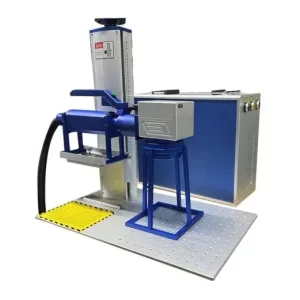
A fiber laser marking machine from lambd uses a ytterbium-doped optical fiber pumped by semiconductor diodes to emit a tightly collimated beam at 1064 nm (near-infrared). At this wavelength, bare metals do not bounce the light away—they absorb 60–80 % of the photon energy and convert it to heat in microseconds. That single physical fact is why a 20 W fiber marker burns a black serial on stainless steel while a 10.6 µm CO₂ laser just glints off the surface and a 455 nm diode scatters uselessly. lambd machines (LM-1-x, LM-11-3, LM-9-2, LM-4-6, T6 Mini) fix the wavelength at 1064 nm, steer it through a two-axis galvanometer at up to 7000 mm/s, and focus it with an F-theta lens to a 30–50 µm spot. Power scales 5 W on T6 Mini to 100 W on enclosed LM-9-2; pulse frequency runs 20–100 kHz on Q-switched sources and up to 4000 kHz on JPT MOPA; repeatability sits at ±0.001 mm; the source is rated ~100,000 hours at <0.5 kW draw. Wavelength is not a spec line—it is the switch that turns "metal reflects laser" into "metal takes the mark".
Stainless Steel: Annealing, Oxidation and Black Code Without Material Loss
On 304 or 316 stainless, a lambd 30 W LM-11-3 in annealing mode (low power, 60–100 kHz, 800–1500 mm/s) heats the surface just below melt. Chromium in the alloy precipitates as a controlled oxide film 0.1–0.5 µm thick—the mark is black, flush, non-tactile, and zero-removal. That is why surgical forceps and food-grade valves use fiber laser instead of engraving: the part keeps its corrosion resistance and smooth profile. Push power to 50 W with slower scan and you get micro-ablation or 0.3 mm deep VIN-class text that survives paint and rust. Either way the 1064 nm photon couples into the steel because steel's absorption curve peaks exactly in the near-IR; CO₂ at 10.6 µm is >85 % reflected and UV at 355 nm, while great for plastic, wastes energy on a material that does not need photochemical breaking. For traceability teams, stainless is the easiest win: ISO/IEC 15415 Grade A Data Matrix in 1.2–1.8 s per code, readable after 500 h salt spray.
Aluminum: Bare Alloy Needs Parameters, Anodized Layer Is a Gift
Bare aluminum reflects more than steel at 1064 nm, but it is far from unmarkable—lambd engineers tune pulse width and frequency so the beam dumps enough peak power to form alumina (Al₂O₃) micro-dots that read as grey or black. A 30 W fiber at 30–50 kHz with 20–30 % power gives a stable grey serial on 6061; 50 W pushes deeper for asset tags. The real shortcut is anodized aluminum: the anodic oxide layer is already a semiconductor-like absorber, so even a 20 W T6 Mini drops a crisp black or white logo at 1500 mm/s without touching the base metal. JPT MOPA takes it further—independent pulse-width control lays down white, blue, gold or red logos by varying oxide thickness via thin-film interference, no pigment, no pre-coat. This is why electronics enclosures, flashlight bodies and premium nameplates standardize on 1064 nm fiber: one wavelength covers bare alloy, anodized finish, and color branding.
Brass and Copper: High Reflectivity Solved by MOPA Pulse Control
Copper and brass sit at the hard end of 1064 nm work—reflectivity can hit 90 % at the surface, so a naive Q-switched beam either skips or pits unevenly. lambd answers with two levers: JPT MOPA sources that shorten pulse duration to <10 ns and raise peak power per pulse, breaking through the reflectivity knee; and optical isolators plus anti-reflection coated field lenses that protect the source from back-scatter. On C360 brass, a 30 W MOPA at 40 kHz, 15 % power, 600 mm/s yields a clean dark-grey QR; on pure copper busbars, 50 W with 2–3 passes gives a 0.15 mm etched serial that a handheld scanner reads through conformal coating. The 1064 nm wavelength still does the heavy lifting—copper's absorption at 1064 nm (~30 %) is low but usable, whereas at 10.6 µm it is near zero and at 355 nm the UV interacts too shallow for industrial contrast. For electrical connectors, radiator nameplates and musical-instrument fittings, fiber is the only single-tool answer.
Why 1064 nm Beats CO₂ and UV on the Metal Floor
Put simply: wavelength matches physics. CO₂ at 10.6 µm is built for acrylic, leather, glass and cardboard—on steel or brass it is 85 % wasted energy and needs spray coatings to fake a mark. UV at 355 nm is brilliant on ABS, glass vials and sapphire, but on metal it either costs 3× the CAPEX or leaves a faint photochemical tint that fails automotive contrast specs. The 1064 nm fiber sits in the sweet band where electro-optical efficiency hits ~28 %, spot size stays 30–50 µm, galvo speed hits 7000 mm/s, and the mark is a physical oxide or recess—not a chemical stain. lambd wraps this into one software stack (EZCAD + JCZ), one spare-part list (lens, galvo, source), and one operator training for LM-11-3 desktop, LM-9-2 enclosed, LM-4-6 handheld and T6 Mini. Buyers comparing "laser for metal tags" who skip the wavelength question buy the wrong machine; buyers who start at 1064 nm and then pick 20 W vs 100 W, MOPA vs Q-switch, get permanent marks on steel, aluminum and brass from the same scientific principle.
Summary: 1064 nm Is the Physics, LAMBD Is the Package
Fiber laser marking works on steel, aluminum and brass because the 1064 nm near-infrared photon is absorbed by the metal lattice, converts to controlled heat, and rewrites the surface as oxide, annealed color or micro-recess—permanent, scannable, zero-ink. Stainless anneals black without losing corrosion resistance; aluminum takes grey on bare alloy and black/white/color on anodized layer; brass and copper yield to MOPA pulse shaping and anti-reflection optics. lambd ships this physics in LM-11-3 30 W benchtops, LM-9-2 100 W enclosed cells, LM-4-6 handheld field units and T6 Mini 5–13 W jewelry markers—all 1064 nm, all JCZ+EZCAD, all ±0.001 mm, all <0.5 kW, all 100,000-hour-rated. For any English-site buyer asking "why fiber and not CO₂/UV for metal," the answer is one number: 1064 nm. LAMBD just turns that number into a machine on the floor.
Post time: 08-14-2026