Why 355 nm Is Called a “Cold” Laser
A 355 nm UV laser is called cold not because it produces no heat, but because it removes material by photochemical bond breaking instead of melting. A 1064 nm fiber laser heats the surface until it oxidizes or melts; a 10.6 µm CO₂ laser is absorbed in the first microns and burns organics. A 355 nm photon, by contrast, carries roughly 3.5 eV of energy — enough to break the molecular bonds of polymers and the Si–O network of glass directly. Material is lifted away layer by layer, with almost no heat conducted into the surrounding zone. This is called the HAZ (heat-affected zone), and on UV systems it is measured in single microns rather than tens of microns. The practical result is what buyers of plastic and glass marking actually need: no melt bead, no burr, no discoloration ring, no micro-crack and no loss of wall strength. On LAMBD equipment — the UV-1-1 mini and the UV T3 split type 3/5/10 W — the beam is delivered at 355 nm through a galvo head and F-theta lens, focused to a 10–30 µm spot, with ±0.001 mm repeatability and a 0.01 mm minimum line width. Cold marking is not a marketing phrase; it is the only reliable way to put a permanent code on a part that cannot tolerate heat.
How Photochemical Ablation Protects Plastic Parts
Plastics fail under fiber and CO₂ marking in different ways. ABS, PVC, PC, PP, PE, PA, PBT and TPU either melt into a raised bead, yellow from thermal degradation, or release irritating fumes. Under 355 nm the same polymers respond to photon energy, not to heat: the bonds absorb the UV quantum, the polymer chain breaks, and a shallow, clean cavity is left behind. That is why a UV mark on plastic has sharp edges, uniform depth and no raised rim — exactly what is needed for a Data Matrix or a fine logo on a small housing. Starting recipes on the UV T3 5 W are conservative by design: 30–60% power, 30–80 kHz, 300–1000 mm/s, 1–2 passes. ABS and PC accept a mark readily at the middle of that window; PP and PE, which are chemically inert and reflective, need either a higher pulse frequency or a second pass; PVC and flame-retardant grades must be run under extraction because chlorine- and bromine-containing fumes are hazardous. Filled grades behave differently from virgin resin: glass-filled PA or PBT etches the resin and leaves the fibers standing, which actually increases contrast, while carbon-filled black plastic marks brightly because the laser removes the surface layer and exposes a lighter core. Two process rules prevent most failures. First, never mark through a release agent, mold-release residue or adhesive label — UV will cure or carbonize it into a dirty edge. Second, stop the fume at the source with a HEPA + activated-carbon extractor, because condensed plume on the F-theta lens changes focus and destroys repeatability within a single shift.
Glass, Sapphire and Silicon: Where UV Has No Competitor
Glass is the material that separates UV from every other marking technology. Soda-lime glass, borosilicate, quartz, sapphire and silicon wafers all transmit or reflect 1064 nm, so a fiber laser either passes through or deposits heat unevenly; CO₂ is absorbed at the surface and creates a ring of tensile stress that turns into a crack within hours. 355 nm is absorbed in a controlled depth of 0.1–1 µm, so the mark is a micro-etched cavity, not a thermal scar. The LAMBD UV T3 3/5/10 W covers three different jobs: 3 W for ultra-fine marking on thin cover glass and optical elements; 5 W as the production default for ampoules, vials, syringe barrels, cosmetic bottles and glass lids; 10 W for faster cycle times on thicker or frosted glass, and for sapphire watch crystals. Typical starting windows are 40–70% power, 40–100 kHz, 200–600 mm/s, 1–2 passes, with lower speed when a frosted rather than clear mark is wanted. Sapphire and silicon need the short-wavelength route as well: sapphire watch faces, LED substrates, silicon wafers and FPC all mark cleanly at 355 nm, and attempts at 1064 nm usually end in chipped edges or subsurface fractures. The chiller is part of the process, not an accessory — the UV T3 runs on water cooling at 20–25 °C ±0.5 °C, and a drifting temperature shifts the beam and the focus. The UV tube itself is rated for 20,000–30,000 hours, roughly a quarter of a fiber source, so hours must be logged and preventive maintenance scheduled.
Construction, Cooling and Protective Measures
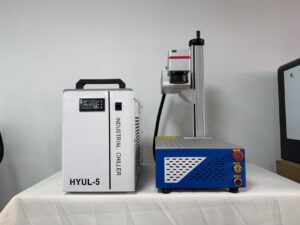
A UV marking system is mechanically simple but optically demanding. The UV T3 split type separates the source and chiller from a compact marking head, which lets the head sit on a conveyor, inside a glove box or above a rotary axis; the UV-1-1 mini integrates the same 355 nm optical chain in a benchtop body for laboratories, jewelry benches and small batches. Power choices are honest: 3 W is enough for ultra-fine work and for heat-critical films, 5 W covers the majority of plastic and glass production, 10 W buys cycle time on high-volume lines. Every LAMBD UV system runs on the same EZCAD + JCZ platform as the fiber and CO₂ ranges, accepts BMP, JPG, GIF, PNG, TIF, AI, DXF, DST and PLT, and imports variable data from Excel via CSV — a necessity for pharmaceutical and medical serialization. Safety is stricter than with fiber because UV radiation outside the beam path is invisible and biologically active. Enclosures, covers and interlocks must prevent access to the optical path and to the source; UV-rated laser safety glasses are mandatory for any unshielded service; and the extractor must handle both plume and ozone. Lens care is the daily discipline: the F-theta and the protective window must be inspected every shift, cleaned only with recommended wipes and solvent, and replaced at the first sign of hazing — a UV mark losing contrast is almost always a dirty optic, not a failing source. LAMBD supplies a 1-year machine / 2-year source warranty, remote commissioning and a shared spare-parts pool (galvo, F-theta, source, chiller) across the whole product family.
How to Choose UV Power and Validate the Mark
Choosing a UV system is a question of cycle time and material, not of “the higher the wattage the better.” Step 1 — identify the material. Clear plastics, thin films, medical polymers, glass, sapphire and silicon all justify 355 nm; metals and paper do not. Step 2 — set the power by throughput. If the part is a cosmetic glass lid at 400–800 pieces per hour, 5 W is the sensible default; if it is a wafer or an optical element where a 10–30 µm feature matters more than speed, 3 W gives finer control; if the line runs thick frosted glass or large plastic panels, 10 W prevents the chiller and the operator from becoming the bottleneck. Step 3 — protect the recipe. Log power, frequency, speed, passes and chiller temperature for every validated job, and keep two files per material — one for a bright mark, one for a deep frosted mark. Step 4 — validate the code. Check 2D codes to ISO/IEC 15415 and linear codes to ISO/IEC 15416; for pharma, verify that the code survives filling, transport, sterilization or cold-chain condensation. Step 5 — calculate TCO honestly. A UV tube lasts 20,000–30,000 hours, so a three-shift line will budget a tube change; against that, the process consumes no ink, no solvent, no labels and no drying energy, and it removes the recall risk that comes from a detached or illegible label. For an English-site buyer the decision is straightforward: if the part is plastic, glass or a semiconductor, and the code must survive the product’s whole life without a crack or a melt bead, 355 nm is not an upgrade — it is the correct tool.
Summary: Cold Marking Is the Only Safe Route for Heat-Sensitive Parts
355 nm UV cold marking exists for the materials that a 1064 nm fiber and a 10.6 µm CO₂ physically cannot handle: transparent and heat-sensitive plastics, glass, sapphire, silicon, FPC, medical polymers and thin films. Its advantage comes from photon energy of about 3.5 eV, which breaks molecular bonds directly and limits the heat-affected zone to a few microns — so there is no melt bead, no discoloration ring, no micro-crack and no loss of wall strength. The mark depth is 0.1–1 µm on glass and a clean shallow cavity on polymers, with a 10–30 µm spot, ±0.001 mm repeatability and a 0.01 mm minimum line width. LAMBD covers the segment with the UV-1-1 mini for laboratories and ultra-fine work, and the UV T3 split type in 3/5/10 W for production: 3 W for wafers and optics, 5 W as the ampoule, vial, syringe and cosmetic-bottle default, 10 W for thick or frosted glass and sapphire. The process is unforgiving of shortcuts — water cooling at 20–25 °C ±0.5 °C, a HEPA + carbon extractor, daily F-theta and window cleaning, UV-rated glasses, interlocked enclosures, and an honest maintenance budget for a 20,000–30,000-hour tube. Software and data are shared with the rest of the range through EZCAD + JCZ and CSV import, and the warranty is 1 year on the machine, 2 years on the source. For an English-site audience the conclusion is simple: where the part cannot tolerate heat, cold marking at 355 nm is not a nicer option — it is the only one that will not crack the part or blur the code.
Post time: 11-09-2026