The Real Difference Is Not the Cooling, but the Wavelength and Duty
Cooling is a supporting system, not a performance category: a buyer should first choose the wavelength (1064 nm fiber, 355 nm UV or 10.6 µm CO₂) and the material, then decide how the heat is removed. Air cooling moves heat from the laser source and electronics to the air with a fan and heat sink; it is simple, has no chiller, no hoses and no freezing risk, and is the default for LAMBD T6 Mini 5–20 W, LM-11-3 20–30 W and LM-1-x MOPA fiber models that draw <0.5 kW from a 220 V/50 Hz outlet. Water cooling circulates coolant through a chiller to stabilise a temperature-sensitive optical path; at LAMBD it is used on UV T3 3/5/10 W, where the chiller holds the crystal at 20–25 °C ±0.5 °C and the UV tube is rated for 20,000–30,000 hours. In other words, air cooling is not “weak” and water cooling is not “stronger” — air cooling is a compact, low-maintenance package for fiber marking, while water cooling is an engineering requirement for UV photonics. CO₂ systems such as CA2-1 30 W, CO₂-1-2 100 W and CO₂-3-4 are a third case: the beam is generated in a tube and cooling is specified by tube power and duty, so the correct comparison is always source type + working hours + workshop conditions, not a generic air-versus-water contest.
Air-Cooled Fiber: The Default for Desks, Shops and On-Site Work
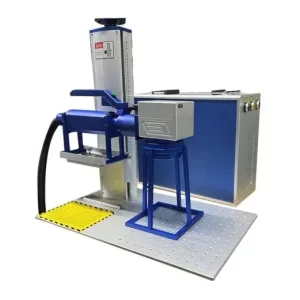
For most marking jobs, air-cooled fiber is the lowest-risk choice. The LAMBD T6 Mini 5–20 W is the entry point for jewellery, keys, gifts and small batches: it focuses the 1064 nm beam into a 30–50 µm spot, delivers ±0.001 mm repeatability and a 0.01 mm minimum line width, and the fiber source is rated for 100,000 hours. Because it is air-cooled and draws <0.5 kW, it runs from a single 220 V/50 Hz phase in a 6–8 m² studio, retail back room or garage — no chiller, no plumbing, no drain. The LM-11-3 20–30 W scales this to production: 110×100 mm field (optional to 300×300 mm), galvo speed to 7000 mm/s, Q-switched source at 20–100 kHz, and the same air-cooled, low-power footprint. For color, white and high-contrast marks on anodized aluminum, brass, copper and titanium, the LM-1-x MOPA family (LM-1-5 20–30 W, LM-1-6 50 W) keeps the same form factor while adding pulse control from <10 ns to ~200 ns at up to 4000 kHz. Air cooling keeps maintenance to a minimum: clean the F-theta lens, check the air intake filter every 3–6 months, keep the rear clearance open and never block the fan. It is the right answer for one-shift work, batch sizes from tens to thousands, metal and hard-anodized plastic, and sites without a chiller or trained cooling staff.
Water-Cooled UV: Mandatory for 355 nm and Cold Marking
A 355 nm UV laser cannot be treated as a “smaller fiber.” Frequency tripling from 1064 nm to 355 nm takes place in a temperature-sensitive crystal, and even a ±0.5 °C drift changes beam stability, output and tube life. That is why every LAMBD UV T3 3/5/10 W is a split-type, water-cooled system with a chiller that controls the crystal at 20–25 °C; the chiller typically draws around 1000 W, and the UV tube is rated for 20,000–30,000 hours. The trade-off is deliberate: water cooling buys you cold marking — photochemical ablation at 0.1–1 µm depth — so ABS, glass, ampoules, vials, syringes, PCBs, FPCs, silicon wafers and sapphire can be marked without burn, crack or heat-affected zone. The UV-1-1 mini covers low-volume and bench work; the T3 split 3/5/10 W is for longer shifts, where chiller stability and a separate optical head matter. Buying rules are strict: allow 4–6 minutes for chiller warm-up, keep the water temperature above the dew point of the workshop to avoid condensation on optics, use only the recommended coolant and change it on schedule, place the chiller on a level surface with free airflow, and protect the circuit from voltage drops. For an English-site buyer the message is direct: if the part is clear, thin-wall, medical, electronic or heat-sensitive, choose 355 nm water-cooled UV first, accept the chiller and the 20,000–30,000 h tube-life discipline, and you avoid the burnt, warped and cracked results that fiber or CO₂ would produce.
CO₂, Mixed Shops and the Three-Wavelength Decision
CO₂ 10.6 µm systems form the third cooling case because the heat load sits in the tube, not in a solid-state fiber source. The CA2-1 30 W integrated marker is the bench and small-batch model for cardboard, wood, leather and acrylic; the CO₂-1-2 100 W adds roll-fed handling for fabric, leather and tags; the CO₂-3-4 split covers large-format signage and panels. Cooling for CO₂ must follow the tube manufacturer’s power and duty specification, and many higher-power tubes use water cooling with a chiller, while lower-power integrated units may be air-cooled — LAMBD quotes the correct chiller and flow for each ordered configuration, so the buyer should never assume “all 30 W is air” or “all 100 W is water.” For a mixed shop, the decision is not one cooler but one workflow: LAMBD fiber (1064 nm), UV (355 nm) and CO₂ (10.6 µm) all run on EZCAD + JCZ, support BMP, JPG, GIF, PNG, TIF, AI, DXF, DST and PLT, and accept variable data from Excel via CSV. This means an operator can mark a metal casing with a T6 Mini or LM-11-3, switch to a UV T3 for a glass or plastic part, and cut an acrylic display on a CO₂-3-4 without relearning the software. A smoke purifier is mandatory for wood, leather, coated materials and acrylic vapor; good extraction protects the lens, improves repeatability and keeps the workshop compliant. The practical split is: air-cooled fiber for metal and small parts, water-cooled UV for heat-sensitive materials, CO₂ (cooling per tube spec) for organics, cutting and signage.
Buying Checklist: 7 Questions That Decide Air or Water
Selection becomes simple when you answer seven questions in order. 1 — What is the material? Metal, hard-anodized plastic and most industrial parts point to air-cooled fiber; clear, thin-wall, medical, electronic or heat-sensitive plastic and glass point to water-cooled UV; cardboard, wood, leather, acrylic, fabric and cutting point to CO₂. 2 — What is the wavelength? 1064 nm for metal, 355 nm for cold marking, 10.6 µm for organics. 3 — What is the duty cycle? Single shift and intermittent work suit air-cooled fiber; multi-shift UV and CO₂ work needs a chiller you can monitor and service. 4 — Is there a chiller and trained staff? If not, start with T6 Mini or LM-11-3 air-cooled and add UV later. 5 — What are the site conditions? Voltage stability, ambient temperature, dust, humidity and dew point decide the chiller specification; UV must stay at 20–25 °C ±0.5 °C. 6 — What are the operating costs? Fiber: electricity and lens tissue; UV: chiller electricity, coolant, filter and 20,000–30,000 h tube life; CO₂: tube, optics and extractor. 7 — Can one software stack cover everything? With LAMBD, the answer is yes — EZCAD + JCZ and CSV variable data run across fiber, UV and CO₂, and the warranty is 1 year on the machine and 2 years on the source. LAMBD also offers remote recipe setup, Russian/English/Chinese menus and a common spare-parts chain (galvo, F-theta, source, chiller, JCZ), so the cooling decision never strands the buyer with incompatible files, fixtures or operators.
Summary: Cool the Right Wavelength, Not the Marketing Hype
Air-cooled versus water-cooled is not a contest between “simple” and “professional.” Air-cooled LAMBD fiber markers — T6 Mini 5–20 W, LM-11-3 20–30 W and LM-1-x MOPA — are the default for 1064 nm marking on metal and hard-anodized plastic: <0.5 kW from 220 V/50 Hz, 100,000-hour source life, ±0.001 mm repeatability and 0.01 mm line width, with no chiller, hoses or drain. Water-cooled LAMBD UV T3 3/5/10 W is the required choice for 355 nm cold marking on glass, clear plastic, PCBs, medical ampoules and heat-sensitive parts: a chiller holds the crystal at 20–25 °C ±0.5 °C, the UV tube lasts 20,000–30,000 hours, and the result is a crack-free code at 0.1–1 µm depth. CO₂ 10.6 µm (CA2-1 30 W, CO₂-1-2 100 W, CO₂-3-4) follows the tube manufacturer’s cooling specification and is the right tool for organics, cutting and signage. All three share EZCAD + JCZ, CSV variable data and common spare parts, so the buyer can scale from one air-cooled fiber into a multi-wavelength shop without retraining. For an English-site audience the takeaway is operational: choose the wavelength by material, choose cooling by source physics and duty cycle, and let LAMBD supply the correct chiller, recipe and support for the job — not the other way around.
Post time: 10-16-2026