Why 10.6 µm Is the Natural Wavelength for Organics
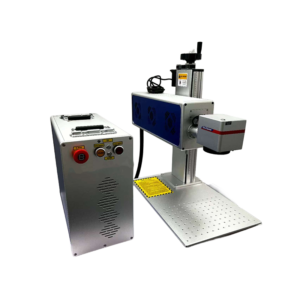
The case for a CO₂ laser at 10.6 µm starts with material physics. Non-metals are transparent or highly reflective to 1064 nm fiber, but they absorb 10,600 nm (10.6 µm) strongly because molecular bonds in cellulose, collagen, polymers and water-containing surfaces couple efficiently to that wavelength. The result is a controlled local reaction: cardboard and wood carbonize to a dark brand mark, leather cuts and textures, acrylic melts and frosts, glass coating ablates, and many films mark without tearing the substrate. A lambd CA2-1 30 W is the bench and small-batch workhorse for marking; a CO₂-1-2 100 W adds roll-fed handling for fabric, leather and tags; and a CO₂-3-4 split system covers large-format signage, panels and plates. The family is built for zero-ink identification: no ink, no ribbon, no label liner, no printhead, no solvent. Compared with inkjet on porous and coated substrates, CO₂ avoids drying time, wicking, smudging and low-contrast codes — the mark is already part of the surface. That is why the question for a buyer is rarely "does CO₂ work," but "which power and format fit my material and volume."
Packaging: Permanent Date, Lot and QR Codes Without Ink
Packaging is the largest CO₂ application because supply chains are moving from printed and glued labels to direct part marking and serialization. A CA2-1 30 W running on cardboard cartons, paper sleeves, wooden crates and some coated boxes produces a date code, lot number, expiry or QR in a fraction of a second; there is no ink reservoir, no make-up fluid, no nozzle wipe and no expiry date on consumables. For secondary packaging, this matters operationally: codes survive stacking, humidity, warehouse handling and re-scanning, while a label can peel, smear or be swapped. For primary packaging such as hang tags and cardstock, CO₂ gives a clean "burned-edge" brand effect that design teams use deliberately — a permanent logo and care code without a woven or printed insert. On film, pouches and thermally sensitive laminates, the boundary shifts: 10.6 µm can cut or mark, but excessive power may melt the web. Here lambd engineers recommend lower power, faster passes and extraction, or a UV 355 nm cold mark when the substrate cannot accept heat. The point is fit-for-purpose: CO₂ is the default for cardboard, wood, leather and many organics; UV takes the heat-sensitive cases; fiber owns the metal.
Wood and Leather: From Utility Marks to Designed Surfaces
Wood is where CO₂ shows both its economics and its creative range. At 30 W, CA2-1 can dark-mark plywood, MDF, solid timber and bamboo for furniture branding, cutting boards, crates, souvenirs and pallet IDs; at 100 W, CO₂-1-2 cuts and engraves faster, while CO₂-3-4 split handles large panels and signage. The interaction is carbonization: the beam drives off moisture and volatiles, leaving a stable dark line with depth that no printed ink can match for outdoor or high-touch use. Parameters stay moderate — typically 10–30 W, 300–800 mm/s, 1–3 passes for a clean dark mark on plywood, with more power and slower speed for deeper engraving — and a smoke purifier is essential because wood smoke and fine char settle on the lens. Leather behaves differently: it is protein-based and sensitive to local burning. For vegetable-tanned and chrome-tanned hides, a CO₂-1-2 100 W roll-fed line marks patches, belts, wallets and bag panels cleanly when power is tuned to color and moisture content; for thin, coated or vegan PU/PVC, the safer route is often UV 355 nm, which marks without edge melt. The practical rule is to prove the recipe on a real hide sample before running a production batch — color, thickness and finish change everything, and one tested EZCAD file removes all guesswork.
Acrylic, Glass and the Cut/Mark Boundary
Acrylic is the showcase application for 10.6 µm, but it also illustrates the importance of controlling the process window. Cast and extruded PMMA absorb CO₂ strongly, so a focused beam either frosts a clean white mark at lower power or cuts a flame-polished edge at higher power. The CA2-1 30 W is ideal for logos, serial numbers, QR codes and sign text on acrylic gifts and displays; CO₂-1-2 100 W and CO₂-3-4 split extend this to larger panels, display stands and architectural letters. A polished frost effect is achieved with shallow, even passes — 20–40 W, 200–500 mm/s, 1–2 passes is a common starting window for clear cast acrylic — whereas cutting requires a tighter focus, slower speed, air assist and good extraction to remove vapor. The same principle applies to glass and glass coatings: CO₂ can etch a coating or create a frosted decorative mark, but bare glass is less absorbent and can chip, so test pieces are mandatory and UV 355 nm is often better for pharmaceutical vials and transparent plastics. For buyers, this is the value of working with lambd: one supplier covers CO₂ marking and cutting plus UV cold marking and fiber DPM, so the engineering decision is made against the material rather than against a limited machine catalog.
Buying the Right lambd CO₂: Power, Format and Workflow
Selection comes down to three questions: what material, what duty cycle, and what throughput. For a shop marking gift boxes, wooden souvenirs, small leather goods and acrylic awards, CA2-1 30 W is the low-entry answer — compact, easy to learn, low maintenance, and capable of clear date/lot/QR marking. For a footwear, apparel, hang-tag, fabric or leather production line, CO₂-1-2 100 W with roll feeding is the productive choice: it pairs marking and light cutting with continuous material handling. For large signs, advertising panels and batch sheet work, CO₂-3-4 split delivers the larger field and mechanical format. Every lambd CO₂ system runs on the same EZCAD + JCZ workflow used by the fiber and UV lines, supports BMP, JPG, GIF, PNG, TIF, AI, DXF, DST and PLT, and imports variable data from Excel via CSV for serialized QR and batch codes. A smoke purifier is not optional for wood, leather, coated materials and acrylic vapor; good extraction protects the lens, improves repeatability and keeps the shop compliant. Because all three wavelengths share software and recipe discipline, a workshop can add CO₂ to an existing LAMBD fiber or UV cell without retraining operators or rebuilding files — and that integration is where the real multi-material advantage lives.
Summary: CO₂ 10.6 µm Earns Its Place on the Packaging and Craft Floor
CO₂ at 10.6 µm is not a substitute for fiber or UV — it is the right answer for a specific and very large family of materials: packaging (cardboard, cartons, hang tags), wood (plywood, MDF, timber, bamboo), leather (patches, belts, hides), and acrylic (signs, gifts, displays), plus many coated and organic surfaces. The lambd lineup turns that physics into a practical choice: CA2-1 30 W for bench and small-batch marking, CO₂-1-2 100 W for roll-fed leather, fabric and tags, and CO₂-3-4 split for large-format work. All three mark without ink, ribbon, labels or solvent; all share EZCAD + JCZ, CSV variable data and a common file set with lambd fiber (1064 nm) and UV (355 nm) systems. The buying discipline is simple but important: prove the recipe on a real sample, control power and speed to stay on the correct side of the cut/mark boundary, fit a smoke purifier, and pick the wavelength by substrate rather than habit — CO₂ for organics, UV for heat-sensitive polymers and glass, fiber for metal and hard anodized plastic. For an English-site buyer, the takeaway is that a CO₂ marker is not a compromise for "soft" materials; it is a high-contrast, permanent, zero-consumable production tool that makes the packaging, wood, leather and acrylic workflow simpler and cheaper than ink ever could.
Post time: 09-28-2026