Choosing the right laser marking machine starts with understanding the three main form factors: desktop, enclosed, and handheld. Each type offers distinct advantages in terms of laser marking machine performance, safety, and cost, making it suitable for specific applications and production environments.
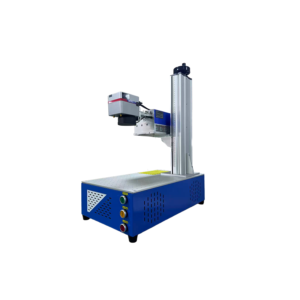
🖥️ Desktop Laser Marking Machines: Compact, Precise & Budget-Friendly
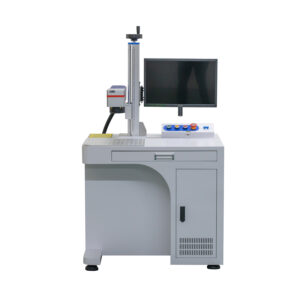
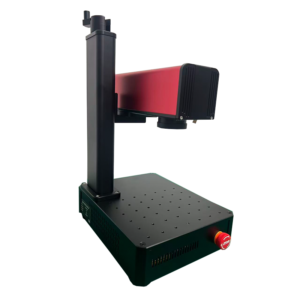
Desktop laser marking machines are compact, benchtop workstations designed for small to medium-sized parts. They integrate a fiber laser source (typically 20–50W), galvanometer scanner, and a small worktable into a single unit.
-
Key Features & Specs
-
Marking Field: A standard field is around 150 × 150 mm, with options for 110 × 110 mm or 200 × 200 mm.
-
Marking Speed & Accuracy: Capable of speeds up to 12,000 mm/s with a minimum line width of around 0.005 mm and repeatability of ±0.001 mm.
-
Power & Consumables: Air-cooled and highly efficient, with a power consumption under 500W and no consumables, ensuring low operating costs.
-
-
Best For
-
Materials: Most metals (stainless steel, aluminum, brass) and some plastics (ABS, PVC).
-
Applications: Ideal for metal fabrication, electronics, jewelry, and small-batch customization where parts can be easily placed under the fixed head.
-
-
Pros & Cons
-
Pros: Low initial investment, small footprint, easy to operate, and excellent price-performance for precision work.
-
Cons: Limited to smaller workpieces and is a manual, single-station process, which may limit throughput for very high-volume needs.
-
🛡️ Enclosed Laser Marking Machines: Engineered for Safety & High-Volume Production
Enclosed laser marking machines are fully enclosed workstations, often with interlocked doors and safety windows, designed to meet strict laser safety standards for industrial environments.
-
Key Features & Specs
-
Safety First: The fully enclosed structure protects operators from laser radiation and fumes. The laser automatically shuts off if the door is opened.
-
Automation Ready: Often equipped with electric Z-axis lifts and optional CCD vision positioning or motorized axes for precise, automated marking, ideal for integration into production lines.
-
Performance: Offers the same high marking speed (≥10,000 mm/s) and accuracy (≤0.001 mm) as desktop models, but with enhanced process control.
-
-
Best For
-
Materials: All metals and a wider range of engineered plastics, including PVC, PC, ABS, and ceramics.
-
Applications: Suited for automotive parts, medical devices, and electronic components that require high-contrast, permanent marks and batch traceability.
-
-
Pros & Cons
-
Pros: Best safety and environmental protection, ideal for 24/7 industrial use, and easily integrated into automated systems.
-
Cons: Higher initial investment and larger footprint. Over-engineering for simple, low-volume tasks.
-
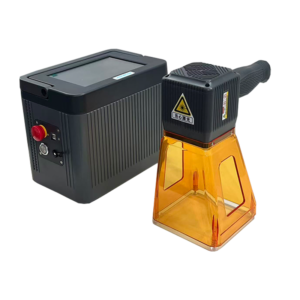
🔋 Handheld Laser Marking Machines: Ultimate Portability for On-Site Jobs
Handheld laser markers consist of a lightweight marking head (typically 6–12 kg) connected by a cable to a separate controller unit, offering maximum portability for marking large, heavy, or immobile parts.
-
Key Features & Specs
-
Power & Performance: Available in 20W to 60W, they deliver industrial-grade marking with speeds up to 12,000 mm/s and accuracy around ±0.01 mm, suitable for serial numbers, QR codes, and logos.
-
Power Options: Feature a dual power supply with options for AC power or a removable lithium battery, enabling continuous operation without access to a fixed outlet.
-
Materials: Can mark a wide range of materials including metals (steel, aluminum, copper) and plastics (ABS, PVC, leather).
-
-
Best For
-
Applications: Perfect for marking large steel structures, pipes, valves, automotive frames, and industrial equipment directly on-site.
-
-
Pros & Cons
-
Pros: Unmatched portability, no need to move heavy parts, and flexible power options for field use.
-
Cons: Requires more operator skill for consistent results, less suitable for ultra-high-volume automated lines, and demands strict adherence to laser safety protocols.
-
🤔 How to Choose the Right Type for Your Business
Selecting the right laser marking solution involves matching the machine type to your specific operational needs. Use this table to guide your decision:
|
Selection Criteria
|
Desktop Laser Marking Machine
|
Enclosed Laser Marking Machine
|
Handheld Laser Marking Machine
|
|---|---|---|---|
|
Primary Use Case
|
Small parts, manual loading, R&D, low-to-medium volume.
|
High-volume production, automated lines, batch traceability.
|
Large, heavy, or immobile parts; on-site field marking.
|
|
Key Advantage
|
Cost-effective, compact, precise.
|
Maximum safety, automation-ready, high throughput.
|
Ultimate portability, flexible power, no part movement needed.
|
|
Safety & Automation
|
Basic operator safety. Manual process.
|
Highest safety (interlocked). Easy to automate and integrate.
|
Requires strict safety procedures. Manual operation.
|
|
Typical Materials
|
Most metals and some plastics.
|
All metals and a wide range of plastics/composites.
|
Most metals and plastics.
|
|
Ideal Industries
|
Jewelry, electronics, small metal parts, gifts.
|
Automotive, medical devices, electronics, hardware.
|
Construction, oil & gas, heavy machinery, large fabrications.
|
💡 Conclusion: Matching the Machine to Your Application
Your choice depends entirely on your specific application. For small, high-precision parts on a budget, a desktop laser marking machine is often the best entry point. When safety, automation, and high-volume consistency are paramount, an enclosed laser marking machine is the industrial workhorse. For marking large, heavy, or immobile objects on-site, a handheld laser marking machine provides unmatched flexibility.
As a leading provider of laser marking solutions, lambd offers a wide range of desktop, enclosed, and handheld laser marking machines. All systems are designed for high-precision, permanent marking on metals and plastics, with options for fiber, UV, and CO₂ lasers to perfectly match your material and application needs. Contact lambd today for expert advice and a tailored solution.
Post time: 08-03-2026