Why a Jewelry-Class Fiber Marker Is the Right First Machine
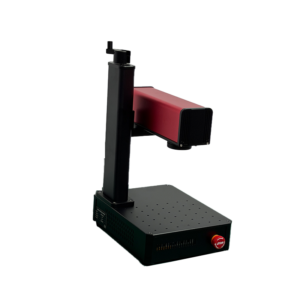
For an Etsy seller or a two-person workshop, the first laser is not a production investment — it is a productivity and branding tool. A lambd T6 Mini fiber marker (5, 10 or 20 W, 1064 nm) fits on a desk, plugs into 220 V/50 Hz, draws <0.5 kW, runs air-cooled, and needs no ink, labels, ribbon or chemical etchant. That single fact changes the unit economics of a small shop: a steel stamp, a copper blank, a brass keychain, a stainless nameplate or an aluminum pet tag goes from "outsourced for $1–3 each plus shipping" to "marked in-house in 20–40 seconds for the cost of electricity." The T6 Mini's spec sheet is built for this: spot 30–50 µm, repeatability ±0.001 mm, minimum line width 0.01 mm, marking speed up to ≤7000 mm/s, working field 110×100 mm (optionally 150×150, 175×175, 200×200 or 300×300 mm via F-theta lens), source life 100,000 hours, and a motorized Z-axis with red-light focus. It runs on EZCAD + JCZ, supports BMP, JPG, GIF, PNG, TIF, AI, DXF, DST and PLT, and pulls variable data (serial, date, QR) straight from Excel via CSV. For a seller already designing in Illustrator or Canva, this means the artwork pipeline stays exactly the same — only the last step becomes "mark instead of print."
What You Can Make: From $8 Pet Tags to $120 Custom Rings
The T6 Mini covers the full small-shop catalog because 1064 nm matches the absorption of the materials these shops already sell. Anodized aluminum (bracelets, pet tags, luggage tags, promotional cards): 20–30 % power, 40 kHz, 1500 mm/s, 1 pass gives a clean white or black logo — no stripping of the anodic layer, so the color stays. Stainless steel (nameplates, keycaps, tumblers, medical-style jewelry): 30–50 % power, 60 kHz, 800 mm/s produces a black UDI-grade mark with zero material loss. Brass and copper (keychains, zipper pulls, guitar picks, coins): 15–30 % power, 40 kHz, 600 mm/s, best with the MOPA option for contrast control. Gold (10K, 14K, 18K), silver and titanium (rings, pendants, bangles): low power, short passes, and a rotary axis for inside-ring engraving — the T6 Mini's ±0.001 mm keeps fonts crisp at 0.5 mm height. A practical price ladder: a plain anodized aluminum pet tag at $8–12 (2–3 min work), a brass keychain at $15–25 (1–2 min), a sterling silver pendant at $40–80 (3–5 min), and a custom ring with inside engraving at $60–120 (rotary, 5–8 min). At 40 pieces a day, the machine pays for itself inside a season — and the seller owns the IP, the turnaround, and the five-star reviews.
Setup in One Day: Unbox, Focus, Mark, Ship
A small shop cannot lose a week to commissioning, which is why the T6 Mini is designed for one-day readiness. Morning — unbox and clear a 600×600 mm corner of a workbench: the standard unit is roughly 800×680×1200 mm with the Z-axis, weighs 35–50 kg, needs a clean, dust-free spot (humidity 5–95 %, non-condensing), and one grounded 220 V/50 Hz outlet. Late morning — install EZCAD on a Windows laptop via the shared installer, plug in the JCZ board over USB, and confirm the dongle driver enumerates. Afternoon — focus and test: place a steel coupon on the worktable, lower the motorized Z-axis until the red dot is sharp, import a DXF or AI file (a name + floral vector), set 20–30 % power, 40 kHz, 600 mm/s, and mark a sample. Within an hour the seller is running real pieces — rings on the rotary axis, tags in a fixture, tumblers held by a simple jig. lambd supports the rest remotely over video and screen share: recipe transfer, barcode quiet-zone checks, hatch direction, and CSV auto-increment for serial numbers. There is no chiller, no water loop, no solvent, and no label applicator to learn — just one software, one cable, one focus routine. For an Etsy seller used to a Cricut or a sublimation printer, the mental jump is smaller than expected.
Five Mistakes Small Shops Make (and How the T6 Mini Avoids Them)
The difference between a side hustle and a sustainable shop is usually process control, not talent. Mistake 1 — burning gold and anodized aluminum. New operators crank power to "make it show up faster," then watch 14K gold discolor or an anodic layer vanish. The fix is the EZCAD recipe library: "Gold_14K_low," "Anod_White_MOPA," "Steel_anneal_60kHz" are saved once and recalled forever, so repeat customers get identical marks. Mistake 2 — crooked marks from freehand placement. A $20 two-pin locating fixture or a rotary axis indexes every piece to the same coordinates; combined with the red-light preview, this turns out 100 identical keychains. Mistake 3 — unreadable QR codes. Scanning the mark on the phone before listing the item catches low contrast early; the T6 Mini's 0.01 mm line width holds module edges even on a 10×10 mm code. Mistake 4 — smoke and fumes indoors. PVC and coated metals need a small smoke purifier (a $150–300 add-on); the T6 Mini's exhaust port makes this a one-hose connection. Mistake 5 — treating the laser like a toy. The T6 Mini is a Class 4 open beam, so a $50 enclosure, interlock, and safety glasses are non-negotiable — and the step up to an enclosed LM-9-2 makes sense only after volume passes ~5,000 pieces per shift. Avoiding these five is how a one-machine shop stays at "handmade quality" without the handmade bottleneck.
From One Machine to a Repeatable Brand
Starting with one T6 Mini is not the ceiling — it is the repeatable foundation. Because the entire lambd fiber line runs on EZCAD + JCZ, every recipe, fixture and workflow built around the T6 Mini transfers directly to a 30 W LM-11-3 for higher throughput, a 50–100 W LM-9-2 for 24/7 production, or a UV T3 3/5/10 W for glass and plastic charms. The small shop keeps the same file formats (DXF, AI, PLT), the same variable-data logic, the same rotary-axis option and the same 1-year machine / 2-year source warranty and 100,000-hour source rating. It also keeps the same zero-consumable economics: <0.5 kW, no ink or label, no printhead, no periodic cleaning cycle — just isopropyl and a lens tissue. This is why "start with one T6 Mini" is not a downsell; it is the lowest-risk way to learn material behavior, pricing, turnaround and quality control on a machine that will still be useful after the shop outgrows it. Etsy sellers, EDC makers, jewelers, trophy shops, gun engravers, promotional-product studios and repair benches all share one truth: the first permanent mark that wows a customer is the moment the business stops being a hobby. With T6 Mini, that moment is roughly one day and one focus routine away.
Summary: One T6 Mini Is the Small Shop's Shortest Path to Permanent Branding
For Etsy sellers and small shops, the case for starting with one lambd T6 Mini is unusually clear. It is a 5–20 W, 1064 nm desktop fiber marker that needs no ink, no labels, no chiller, no solvent; it draws <0.5 kW from a single 220 V/50 Hz outlet, delivers ±0.001 mm repeatability, 0.01 mm line width, 100,000-hour source life and ≤7000 mm/s marking; and it runs on EZCAD + JCZ with full variable-data support from Excel via CSV. That single machine turns outsourced stamps, tags, keychains, pendants and rings into in-house products finished in 20–40 seconds, at price points from $8 pet tags to $120 custom rings, with payback measured in a single season at 40 pieces per day. Setup takes one day: unbox, install, focus, mark, ship — with remote support from lambd for recipes, fixtures and scanner checks. The five classic small-shop mistakes (burning, crooked marks, unreadable QR, fumes, unsafe operation) are solved with saved recipes, locating fixtures, pre-scanning, a smoke purifier and a basic enclosure. And when volume grows, the T6 Mini does not become obsolete: its recipes, files and workflows move directly onto the lambd LM-11-3, LM-9-2 and UV T3 line. For an English-site buyer, the takeaway is operational — start small, mark permanently, scale without relearning the software.
Post time: 09-16-2026