
Handheld vs. Desktop: Choosing the Right Laser Marker for Your Needs
1. The Mobility Factor: Fieldwork vs. Fixed Stations
When deciding between a handheld and a desktop laser marker, the first consideration is the nature of your work environment. Handheld laser markers are designed for maximum mobility. They are compact, lightweight (often around 6-7kg), and often feature built-in batteries, allowing for true "on-the-go" operation. This makes them the ideal choice for fieldwork, such as marking large pipes on a construction site, serial numbers on installed machinery, or VIN codes on vehicles where moving the object to a workshop is impossible. In contrast, desktop laser markers are stationary units designed for a fixed workstation. They offer a stable platform for batch processing smaller items like jewelry, electronic components, or personalized gifts. If your business requires you to travel to the client or handle oversized objects, the handheld model provides the necessary flexibility that a desktop unit cannot match.
2. Precision and Consistency: Manual Control vs. Automated Accuracy
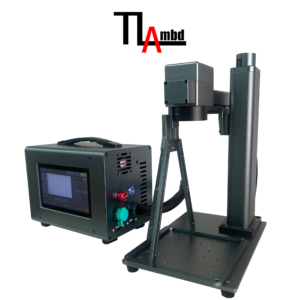
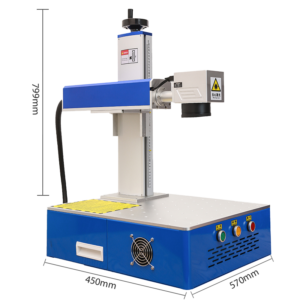
The second critical difference lies in the precision and consistency of the mark. Desktop laser markers excel in high-precision applications. Because the laser head is fixed and the workpiece is placed on a stable platform (often with a lifting pillar for focus), these machines can achieve micron-level accuracy repeatedly. This is crucial for industries like electronics or medical devices where clarity and exact positioning are non-negotiable. On the other hand, handheld laser markers rely on the operator's steady hand and skill. While modern handheld units feature user-friendly interfaces and safety guides, the "human factor" introduces a slight variable in consistency compared to the automated precision of a desktop model. For intricate logos or tiny text on small parts, the desktop version is the superior choice for guaranteed quality.
3. Operational Speed and Workflow Efficiency
Your production volume and workflow will dictate which machine integrates better into your business. Desktop laser markers are built for speed and efficiency in a production line setting. They allow for rapid part loading and unloading, and with compatible software, can process hundreds of identical items with minimal supervision. This makes them the backbone of mass customization and industrial part marking. Conversely, handheld laser markers are optimized for speed of setup rather than pure marking speed. There is no need to adjust clamps or fixtures; you simply point and shoot. This saves significant time in maintenance scenarios or one-off customizations where the setup time for a desktop machine would exceed the marking time itself. If you value rapid deployment over high-volume throughput, the handheld model wins.
4. Cost Implications and Space Requirements
Budget and physical space are practical constraints for any purchase. Generally, handheld laser markers have a lower barrier to entry regarding initial cost and space. They are compact enough to fit in a car trunk or a small shelf and require no dedicated workstation, making them perfect for startups or mobile technicians. Desktop laser markers, while potentially requiring a higher initial investment and a dedicated bench space, offer a more robust infrastructure. They often support higher power configurations and more sophisticated rotary attachments for marking rings or bottles, which might be cumbersome to attach to a handheld unit. When calculating ROI, consider not just the price tag, but the value of the floor space and the specific accessories you need.
5. Application Versatility: Niche Solutions
Finally, consider the specific materials and the complexity of the tasks. Both types from brands like Lambda Laser (犀角激光) utilize advanced fiber laser technology suitable for metals and many plastics. However, the handheld laser marker shines in niche applications involving large-scale or immovable industrial parts, such as marking serial numbers on steel beams or elevator components directly on-site. The desktop laser marker is the go-to for detailed artistic work, deep engraving on smaller surfaces, and high-volume industrial marking where the part can be brought to the machine. Your choice should align with whether your primary challenge is "accessing the part" (choose handheld) or "perfecting the mark on the part" (choose desktop).
Conclusion
Choosing between a handheld and a desktop laser marker ultimately depends on the mobility of your subjects and the precision of your requirements. If your work involves large, fixed, or field-based objects, the handheld laser marker offers unmatched flexibility and convenience. If you require high-volume, high-precision marking on smaller, movable items within a workshop, the desktop laser marker is the industry standard for reliability and quality. Assess your daily workflow honestly: do you go to the work, or does the work come to you? Answering this will guide you to the right investment.
Post time: 04-29-2026