What Makes Fiber Laser the Backbone of Modern Metal Traceability
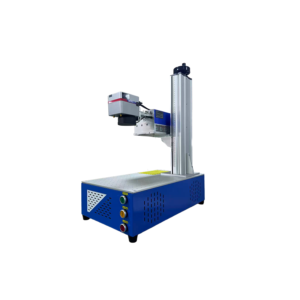
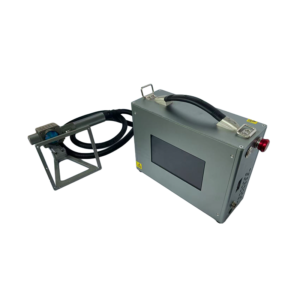
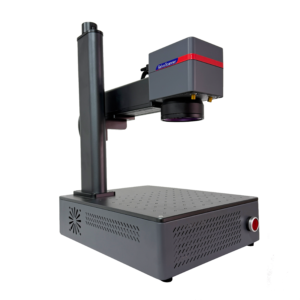
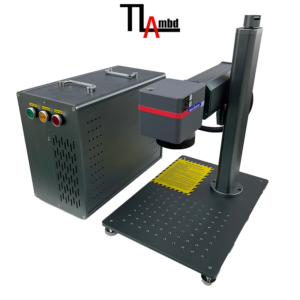
A fiber laser marking machine uses a 1064 nm solid-state fiber source to alter the surface of metal by annealing, oxidation, or micro-engraving—leaving a permanent, tamper-proof identifier directly on the part itself. lambd fiber markers (desktop LM-1-x, enclosed LM-9-2, handheld LM-4-6, Mini Fiber 20 W–50 W) run on MAX, RAYCUS, or JPT MOPA sources with JCZ control cards and EZCAD software, delivering ≤7000 mm/s marking speed, ±0.001 mm repeatability, 0.01 mm minimum line width, and a 100,000-hour source life at under 0.5 kW power draw. Unlike inkjet, dot-peen, or adhesive labels, the mark is physically part of the steel, aluminum, titanium, or brass—so it survives heat, oil, salt spray, vibration, and sterilization. This turns every shaft, bracket, valve, and surgical tool into a self-contained data carrier: a Data Matrix, QR, or serialized alphanumeric that a vision scanner reads at any station from incoming inspection to MRO. For regulated supply chains, fiber laser is no longer an option; it is the DPM (Direct Part Marking) baseline referenced by ISO/IEC 16022, SAE AS9132, and FDA UDI.
From Ink and Labels to Permanent DPM: Why the Shift Happened
Legacy traceability relied on CIJ ink on cartons, sticky labels on crates, or dot-peen stamps on heavy castings—each breaks at the worst moment. Ink smears in oil, labels peel in autoclave or freezer, peen marks crack on fatigue-loaded fasteners. Fiber laser removes the middle layer: no ink SKU, no ribbon, no adhesive, no printhead, no legibility decay. A lambd 30 W LM-11-3 stamps a 12×12 cell Data Matrix on a stainless coupling in 1.5 seconds with grade A contrast per ISO/IEC 15415; the same code still scans after 72 h salt spray and 200 °C bake. Automotive Tier-1 suppliers switched because IATF 16949 and OEM recall rules demand that a brake caliper or injector carry its own birth record—not a box label that gets discarded at line-side. Aerospace went first: SAE AS9132 UID on turbine blades survives 30-year service. Medical followed with UDI on scalpels and implants that must read after 100 EtO or steam cycles. The trigger was not “laser is cool,” but that legacy marks fell out of the traceability chain exactly when audits got stricter.
How lambd Fiber Machines Engineer the Traceable Mark
Under the hood, lambd fiber markers convert a variable dataset into a permanent mark through five controllable levers: wavelength (1064 nm fixed), pulse frequency (20–100 kHz Q-switch, up to 4000 kHz on JPT MOPA), power (10 %–100 % of 20/30/50/100 W), galvo speed (up to 7000 mm/s), and focal spot (30–50 μm via F=160 field lens). EZCAD pulls serial, lot, date, and QR content from Excel or MES via CSV, renders BMP/AI/DXF/PLT, and fires the JCZ card—so every part gets a unique code without operator typing. On 304 stainless, annealing mode (low power, high frequency) gives a black, non-removable code with zero material loss, ideal for medical tools. On anodized aluminum, JPT MOPA tunes pulse width to drop a white or colored logo without burning the oxide. On carbon steel, 50 W deep-engraves 0.3 mm VIN-class text that a handheld scanner reads through paint and rust. Optional CCD verifies the printed grade inline; optional rotary axis marks around shafts and rings. The result is a closed loop: MES issues the number → laser writes it → camera confirms it → database binds it to the physical part for life.
Industry Proof: Automotive, Aerospace, Medical, Electronics
In automotive, lambd 50 W enclosed LM-9-2 marks engine brackets, ABS sensors, and battery busbars with Data Matrix tied to IATF 16949 records; recall scope shrinks from “all 2025 Q3 units” to 480 specific shafts. Aerospace machine shops laser UID per SAE AS9132 on titanium fittings and aluminum spars—marks survive anodize strip and repaint because they sit below the coating. Medical contract manufacturers run 20 W Mini Fiber or 30 W LM-11-3 to anneal UDI on stainless forceps and titanium plates; codes pass 100 sterilization cycles and read at 99.8 %+ against the 96 % typical of etched tags. Electronics subcontractors use 20 W fiber for serialized QR on aluminum heatsinks and brass connectors where CIJ would contaminate the clean room. Across these sectors the pattern repeats: traceability stops being a paperwork exercise and becomes a physical property of the metal. Auditors no longer “trust the logbook”; they scan the part.
Total Cost of Ownership and the 12–30 Month Cross-Over
The procurement objection is always “laser CAPEX is 2–3× a CIJ printer.” The answer is TCO. A CIJ line spends USD 2,000–4,000/year on ink, solvent, filters, and printhead service; 3-year TCO lands USD 10,800–18,800 on a USD 3,000–5,000 machine. A lambd 30 W fiber marker costs more upfront (mid-range desktop/enclosed USD 2,000–6,000) but adds only electricity—under 0.5 kW, roughly USD 300–400/year—and zero fluid, ribbon, label, or nozzle budget. With 100,000-hour source life, no optical parts to replace for 5–7 years, and read-rate climbing from 96 % to 99.8 %, the curves cross at 12–30 months; years 3–8 are almost pure savings plus avoided recall and rework risk. For metal part traceability specifically, the laser also kills the hidden cost of “orphan parts”—components that lost their label and must be scrapped or 100 % inspected. Permanence is not a feature here; it is the entire business case.
Summary: Fiber Laser Turned the Metal Part Into the Database
How fiber laser marking machines are reshaping metal part traceability comes down to one shift: the identifier moved from the package to the part. A lambd fiber marker at 1064 nm, ±0.001 mm, ≤7000 mm/s, and 100,000-hour life writes Data Matrix, QR, serial, and UDI straight into steel, aluminum, titanium, or brass—permanently, legibly, and at line speed. It satisfies SAE AS9132, ISO/IEC 16022, FDA UDI, and IATF 16949 without ink, labels, or peen-induced cracks, and it closes the loop with MES and CCD so the physical object and the digital record are never allowed to drift apart. For automotive, aerospace, medical, and electronics suppliers, traceability is no longer a logbook someone might forge; it is the metal itself answering the scanner. In 2026 procurement language, fiber DPM is not the future of metal traceability—it is the current baseline, and lambd ships it in desktop, enclosed, handheld, and mini forms ready for the shop floor.
Post time: 08-12-2026