Why 1064 nm Fiber at 5–13 W Is the Sweet Spot for Rings and Bracelets
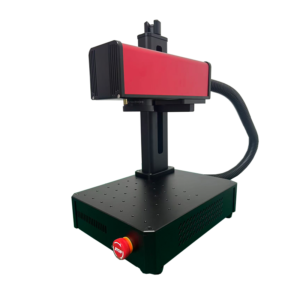
A jewelry studio does not need a 50 W industrial fiber marker — it needs beam control, not raw depth. The lambd T6 Mini Fiber ships at 5 W, 10 W or 13 W, all emitting 1064 nm through a Ytterbium-doped fiber, focused by an F-theta lens to a 0.01 mm line width and ±0.001 mm repeatability. That tight spot lets you put a 0.5 mm tall serif name on the inside of a 2 mm wedding band without burning the edges, while a 50 W machine would risk warping thin gold or silver. The T6 Mini body is 360 × 200 × 400 mm and 5 kg, draws <0.5 kW from a 220 V/50 Hz outlet, runs on JCZ board + EZCAD, imports AI/DXF/BMP/PLT, and carries a 100,000-hour source rating — so a boutique engraving 40 rings a day gets industrial-grade permanence with a desk-top footprint. For precious metals (gold 14K–24K, sterling 925, platinum, titanium, stainless), 1064 nm is absorbed well enough to ablate or anneal a crisp mark, yet low enough in power at 5–13 W to stay forgiving on heat-sensitive bands.
Inside-Band Text, Dates and Coordinates: Rotary Axis Workflow
The difference between "laser-etched" and "jeweler-grade" is the rotary chuck. The T6 Mini accepts a standard jewelry rotary axis (expandable mandrel or 3-jaw chuck) driven inside EZCAD: you load the ring on the mandrel, set the ring diameter in the software, and the galvo plus rotary sync to wrap text 360° along the inner circumference. Typical inside-band job on sterling silver: 10 W, 20–40 kHz, 500–1000 mm/s, 1–2 passes, 0.03 mm hatch spacing — a name plus date lands in ~25–40 seconds with a contrasting dark mark and no mechanical contact. Bracelets and bangles go the same way: slide the cuff onto a larger mandrel, or clamp a flat ID plate on the 110 × 110 mm work table for coordinates, initials, GPS lat/long, or a 6-digit serial. Because the beam never touches the metal, there is no burr, no clamp scar, and no polishing step beyond a light buff — the exact reason gift shops switch from pantograph engravers to fiber.
Gold, Silver, Titanium: Power and Speed Numbers That Do Not Burn
Precious metals dissipate heat fast and reflect hard, so the T6 Mini lives or dies on parameter discipline. Sterling silver surface mark: 10 W at 30–50 % power, 800–1200 mm/s, 30–60 kHz, 1 pass. 14K–18K gold: 10 W at 20–30 % power, 500–1000 mm/s, 20–40 kHz — push past 35 % and you brown the alloy near the stroke. Titanium and stainless bands: 13 W at 40–60 % power, 300–600 mm/s for a darker anneal mark. Deep engraving (0.1–0.3 mm) on a cuff: drop to 200–400 mm/s, 5–10 passes, 70–90 % power on 13 W. Always dry-run with the red focus pointer, clean the piece with isopropyl alcohol, and test on a scrap blank of the same alloy — silver and gold both throw false contrast if oils remain. The T6 Mini's Q-switch frequency range 20–80 kHz and adjustable PWM 0–20 let a junior operator lock a recipe per alloy and recall it from the EZCAD preset list, so the 50th ring looks like the 1st.
Beyond Text: Monograms, QR Micro-Codes, Fingerprints and Batch Serials
Personalization is no longer just "John ♥ Mary 2026". With the T6 Mini's 0.01 mm line width you can etch a 1.2 mm high micro-logo on a pendant bail, a Data Matrix or QR code 3 × 3 mm on a cuff tag that links to a certificate URL, or a client fingerprint vector on a memorial pendant — all from a 110 × 110 mm field, all vector-driven in EZCAD. Variable data from Excel drops names, order numbers and dates automatically, so a 20-piece bridesmaid-gift batch finishes in one jog. For jewelers doing repairs, the same 13 W head anneals a discreet inventory serial on the inner shank that survives re-sizing and re-plating, beating punch stamps that crack thin bands. Because the source is 1064 nm fiber with no lamp and no water chiller, the shop runs silent, cool, and zero-consumable — no foil, no diamond tip wear, no pantograph template library to store.
T6 Mini vs a 30 W Bench Fiber: Buy the Power You Actually Fire
A 30 W LM-11-3 is the right tool for tool-steel tags and 0.3 mm deep VIN codes; on a 1.5 mm gold band it is 3× the energy you will ever use and 4× the bench space. The T6 Mini 10 W hits the real jewelry window: enough to anneal silver, surface-mark gold, and 5-pass engrave a cuff, while the 5 kg body slides into a display-case corner for walk-in personalization. lambd keeps both machines on the same JCZ + EZCAD stack, same lens thread, same 100,000-hour source philosophy — so a studio can start on T6 Mini and add an LM-11-3 later without re-training staff. For ring-and-bracelet personalization the buying rule is simple: if your deepest job is 0.3 mm on a cuff and your daily mix is gold/silver/titanium, 5–13 W 1064 nm fiber with a rotary chuck is the whole answer; bigger watts just heat the room.
Summary: The T6 Mini Turns a Ring Into a Permanent Story
Jewelry personalization lives on precision, not power. The lambd T6 Mini Fiber at 5–13 W, 1064 nm, ±0.001 mm, 0.01 mm line, 110 × 110 mm field, JCZ/EZCAD, 5 kg and <0.5 kW is the exact instrument for inside-ring names, anniversary dates, coordinate bracelets, micro-QR certificates, and batch serials on gold, silver, titanium and stainless. A rotary chuck wraps text 360° with no clamp scar; per-alloy EZCAD recipes stop junior operators from browning gold; zero consumables and 100,000-hour source life make the per-piece cost a rounding error next to pantograph foil and diamond tips. For an English-site buyer searching "fiber laser for rings and bracelets", the takeaway is operational: lambd T6 Mini is not a shrunk factory marker — it is a jewelry-grade marker that happens to sit on a desk, fire in 25 seconds, and outlast the shop's first decade.
Post time: 08-19-2026