Why Anodized Aluminum Color Marking Depends on Pulse-Width Control
Anodized aluminum carries a porous aluminum-oxide (Al₂O₃) layer, typically 5–25 µm thick, that is dyed or sealed after anodizing. When a 1064 nm fiber laser marks this surface, the result is governed not only by power but by pulse width — the time each burst of energy stays on the material. A standard Q-switched fiber source (used in lambd LM-11-3 30 W and T6 Mini 20 W) fires a fixed pulse width of roughly 90–120 ns at 20–100 kHz, so the heat input is coarse: it boils the dye or micro-ablates the oxide, producing a black or grey mark, but it cannot create color. A JPT MOPA source — available in lambd LM-1-5 and LM-1-6 — decouples pulse width from frequency, letting the operator set pulse width independently (from <10 ns up to ~200 ns and beyond) while pushing frequency to 4000 kHz. This fine control manages the temperature-time curve at the surface, restructuring or thickening the oxide so that thin-film interference generates white, blue, gold, red or green marks without any pigment, ink, or pre-coat. All lambd fiber markers share the same platform: JCZ control card, EZCAD software, ±0.001 mm repeatability, ≤7000 mm/s galvo speed, 100,000-hour source life, and <0.5 kW air cooling at 20–30 W.
Q-Switched Fiber Laser on Anodized Aluminum: Monochrome and Fast
A Q-switched fiber laser is the workhorse for monochrome anodized aluminum marking. With pulse width fixed at ~90–120 ns and frequency limited to 20–100 kHz (20–80 kHz on T6 Mini), the beam deposits heat in a single, unchangeable manner. On black anodized aluminum, it vaporizes the organic dye and leaves a bright silver-grey or white-ish contrast; on clear or colored anodized layers, it typically carbonizes the surface into a dark grey or black code. The mark is permanent, scannable, and fast — a lambd LM-11-3 30 W stamps a 12×12 Data Matrix on an anodized tag in about 1.5 s at 110×110 mm field. The disadvantage is aesthetic and thermal: because the pulse cannot be shortened, excess heat spreads into the anodic layer, risking a burnt halo, micro-cracking, or removal of the oxide on thin (<10 µm) coatings. There is no true “color” mode — only shades from silver to black. For industrial traceability where a QR or serial must simply be read by a scanner, Q-switched is ideal: lower CAPEX, simpler EZCAD recipes, and zero consumables. It is the right choice for EV battery tags, electronic enclosures, and anodized nameplates that need black-on-black contrast, not decoration.
JPT MOPA Fiber Laser: Independent Pulse Width Unlocks White and Color
The JPT MOPA (Master Oscillator Power Amplifier) architecture in lambd LM-1-5 and LM-1-6 changes the game. Because the seed laser is modulated before amplification, pulse width is independent of frequency: an operator can fire a short pulse (<10 ns) at high peak power to create a “cold” interaction, or stretch to 100–200 ns for deeper thermal effect. On anodized aluminum this produces three distinct results. First, white marking: very short pulses at high frequency generate microscopic bubbles or foam inside the oxide layer that scatter light, yielding a bright, opaque white logo on black anodized parts without removing the anodic film — the finish used on premium electronics. Second, color marking: by tuning pulse width, frequency and scan speed, the laser grows the oxide to a precise thickness (typically 0.1–0.5 µm of additional structure), and thin-film interference reflects specific wavelengths — blue, gold, red, green — with no pigment and no post-process. Third, deep black: longer pulses carbonize or texture the surface for maximum contrast. A lambd MOPA 30 W marks a colored logo on an anodized flashlight body in 3–5 s, all saved as EZCAD recipes (“Anod_White_MOPA”, “Anod_Gold_MOPA”). The source keeps ±0.001 mm repeatability, ≤7000 mm/s, and the same 100,000-hour rating, but adds roughly 1.5–2× the CAPEX of a Q-switched unit.
Head-to-Head: Parameters, Cost and Real Applications
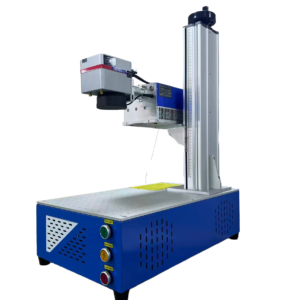
Put the two side by side and the trade-off is clear. Pulse width: Q-switched fixed at ~90–120 ns; MOPA adjustable from <10 ns to ~200 ns+. Frequency: Q-switched 20–100 kHz; MOPA up to 4000 kHz. Color capability: Q-switched only monochrome silver/black; MOPA white plus interference colors (blue, gold, red). Thermal damage: Q-switched risks halo and oxide removal on thin anodic layers; MOPA short pulses stay “cold”, preserving the film. Speed: both scan at ≤7000 mm/s, but MOPA color runs slower because it needs several passes or reduced speed to build oxide thickness; mono Q-switched marking is faster per part. Cost: a lambd LM-11-3 30 W Q-switched desktop is the entry choice; a lambd LM-1-5 20–30 W MOPA costs more but adds white/color. Applications: Q-switched wins in high-volume traceability — anodized EV battery tags, serialized electronic enclosures, Data Matrix on black anodized brackets (lambd LM-9-2 50 W enclosed for lines). MOPA wins in brand-facing work — white Apple-style logos on black anodized laptop shells, gold/blue logos on promotional anodized gifts, premium cosmetic caps (lambd LM-1-6 50 W). Both are ink-free, air-cooled below 0.5 kW at 20–30 W, run JCZ + EZCAD, and use the same rotary-axis and F-theta options, so a shop can standardize on one software stack.
How to Choose the Right lambd Machine for Anodized Jobs
Selection starts with the question: do you need the code to be read, or do you need the mark to be seen? For traceability — a 12×12 Data Matrix, serial, or QR that a scanner reads on an anodized aluminum tag — a Q-switched lambd LM-11-3 30 W or enclosed LM-9-2 50 W is the value answer: it marks in 1.5 s, holds ISO/IEC 15415 Grade A, and costs less. Choose JPT MOPA (lambd LM-1-5 20–30 W, LM-1-6 50 W) when the anodized part is customer-facing and needs a white foam mark on black anodize, or a colored logo (gold, blue, red) for brand differentiation; the adjustable pulse width also saves thin or dyed anodic layers that a Q-switched beam would burn. Mixed shops often run both: a T6 Mini 20 W or LM-11-3 for mono production codes, and an LM-1-5 MOPA for color branding, all on the same EZCAD, lens thread, and spare-part list. Always degrease the anodized surface with isopropanol, proof on scrap of the same alloy and coating thickness, and store a recipe per result. For color, inspect the sample under the lighting of the final product because interference shades shift with viewing angle. lambd supports both lines with English EZCAD, remote parameter setup, and a 100,000-hour source warranty.
Summary: Pulse Width Is the Switch Between Monochrome and Color
On anodized aluminum, the difference between a Q-switched and a JPT MOPA fiber laser is not watts or speed — it is pulse width control. A Q-switched source (lambd LM-11-3 30 W, T6 Mini 20 W) fires a fixed ~90–120 ns pulse at 20–100 kHz, delivering fast, permanent silver-to-black marks and excellent QR/Data Matrix contrast, but no true color and a risk of burning thin anodic layers. A JPT MOPA source (lambd LM-1-5, LM-1-6) makes pulse width independent, so short pulses create a bright white foam mark, and tuned widths grow the oxide to reflect blue, gold, red or green by thin-film interference — all without ink, pigment, or pre-coat. Both share the lambd 1064 nm platform: JCZ + EZCAD, ±0.001 mm, ≤7000 mm/s, 100,000-hour source, <0.5 kW air cooling, and zero consumables. The buying rule is operational: scanner-readable traceability codes on anodized tags belong on Q-switched; white or colored brand logos on anodized enclosures belong on JPT MOPA. lambd builds both, so one workshop can run monochrome production and color customization from a single software stack, one spare-part shelf, and one service contract.
Post time: 08-31-2026