Core Specifications: What the 30W Q-Switched Platform Actually Delivers
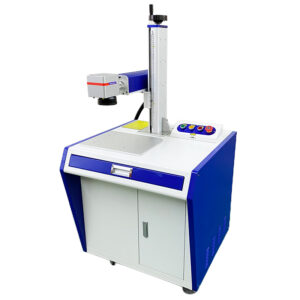
The LAMBD LM-11-3 is a compact desktop fiber laser marking machine built around a 1064 nm ytterbium-doped fiber source (MAX, RAYCUS or JPT), a two-axis galvanometer scanning head, and an F-theta focusing lens. The standard model runs at 30 W average power with a fixed pulse width of ~90–120 ns in Q-switched mode, frequency adjustable 20–100 kHz (PWM 0–20), and beam quality M² 1.2–1.8. It focuses to a 30–50 µm spot, delivering ±0.001 mm repeatability, 0.01 mm minimum line width, and 0.5 mm minimum character height. The default marking field is 110×100 mm, optionally expandable to 150×150, 175×175, 200×200 or 300×300 mm by changing the F-theta lens. Engraving line speed reaches ≤7000 mm/s, the laser head carries a 100,000-hour theoretical service life, and the whole machine draws <0.5 kW from a 220 V/50 Hz single-phase supply. Cooling is forced air — no chiller, no water lines. Control is handled by a JCZ board running EZCAD software, supporting BMP, JPG, GIF, PNG, TIF, AI, DXF, DST and PLT file formats. The full unit typically measures around 800×680×1200 mm with a motorized Z-axis and red-light focus pointer.
Marking Speed: How 7000 mm/s Translates to Real Parts
The headline ≤7000 mm/s is the galvanometer's vector jump-and-mark ceiling, not the sustained speed of every job — but it matters because it sets the floor for cycle time. On a stainless steel coupling, a 12×12 Data Matrix (ISO/IEC 15415 Grade A) lands in ~1.5 seconds at 30 W, 50 % power, 60 kHz and ~600 mm/s marking speed with a 0.02 mm hatch. On black-anodized aluminum, the same 30 W cleans a white logo at ~1500 mm/s in a single pass, so a 20×20 mm graphic takes 2–4 seconds. A serial number + QR code on a 6061 bracket (30–50 % power, 40 kHz, 500 mm/s, 2 passes) completes in roughly 3–5 seconds per part. Because the Q-switched source fires at fixed 90–120 ns, there is no pulse-width tuning — speed is controlled by frequency, power percentage, hatch spacing and scan velocity. For batch jobs, EZCAD pulls serial, date, lot and QR data directly from Excel via CSV, so a 500-piece run auto-increments without operator input. The 30 W LM-11-3 therefore fits small-to-medium workpieces where single-part handling time, not laser dwell time, is the bottleneck.
Throughput Calculation: Pieces Per Hour on the LM-11-3
Throughput is not just "speed"; it is cycle time × uptime. Take a typical job: mark a 15×15 mm 2D code + 3 lines of text on a steel nameplate, 2-second laser dwell, 4-second load/unload, no rotary. Cycle time = 6 seconds → 600 parts/hour, 4800 parts/8-hour shift (assuming 100 % uptime). If the part needs a rotary axis (ring, tube, vial) adding 3 seconds per side, throughput drops to ~400 parts/hour. For a fly-marking or conveyor-fed line, the LM-11-3's 7000 mm/s galvo means the beam re-positions in microseconds between parts, so throughput is limited only by part spacing and detector trigger — easily 1200–2000 parts/hour on small tags. Compare this to a CIJ inkjet: same part might need 5 seconds dwell + 2 seconds dry time + label alignment, plus ink/ribbon cost and periodic cleaning. The LM-11-3 runs 24/7 in theory (100,000 h source, air-cooled, no consumables), but for production cells exceeding ~5000 parts/shift or running 24/7, lambd recommends the enclosed LM-9-2 50–100 W with interlock and CCD vision instead.
Material Coverage and Parameter Starting Points
The LM-11-3 30 W Q-switched marker handles all metals and some non-metals — stainless, carbon steel, aluminum (bare and anodized), brass, copper, titanium, magnesium, zinc alloys, plus hard plastics like ABS, nylon and epoxy. Stainless steel annealing (low power, 60–80 kHz, 800–1500 mm/s) gives a black, zero-material-loss UDI code. Anodized aluminum (20–30 % power, 40 kHz, 1500 mm/s, 1 pass) yields a clean white or black logo. Bare 6061 aluminum (30–50 % power, 40–60 kHz, 500–800 mm/s, 2 passes) forms grey Al₂O₃ micro-dots. Brass and copper (15–30 % power, 40 kHz, 600 mm/s) need the MOPA option on LM-1-5/1-6 for <10 ns pulses; the standard Q-switched LM-11-3 still marks them but with less contrast control. Magnesium AZ31B (30–50 % power, 60 kHz, 500 mm/s, 2 passes) and ZAMAK zinc (15–25 % power, 45 kHz, 900 mm/s, 1 pass) are covered in detail in dedicated lambd guides. Minimum marking depth is 0–1 mm depending on material; deep engraving to 0.3 mm takes 5–10 passes at 200–400 mm/s and 70–90 % power. Always degrease with isopropanol and test on scrap of the same alloy.
Workspace, Software and Total Cost of Ownership
The LM-11-3 sits on a desktop footprint (default 110×100 mm working area, motorized Z-axis for focus), weighing roughly 35–50 kg in the standard configuration. It needs a clean, dust-free environment (humidity 5–95 %, non-condensing) but no special HVAC beyond standard workshop conditions. EZCAD runs on Windows, supports variable data marking (serial, date, batch, QR auto-increment), and stores per-alloy recipes so operators recall rather than re-engineer parameters. The 1-year machine / 2-year laser warranty plus 100,000-hour source rating mean the five-year cost is dominated by electricity (~0.5 kW × 8 h × 300 days ≈ $120/year at US commercial rates) and occasional lens cleaning — no ink, no ribbon, no printhead, no label stock. Versus CIJ, the break-even is typically 12–30 months in a two-shift shop; after that the LM-11-3 is essentially a fixed-cost asset. Optional upgrades include a rotary axis (rings, tubes, bottles), smoke purifier (PVC, coated metals), foot pedal, CCD camera for auto-alignment, and a larger F-theta lens for 200×200 or 300×300 mm fields. Everything stays on the same JCZ + EZCAD stack as the rest of the lambd fiber lineup, so a shop can add an LM-9-2 or T6 Mini later with zero retraining.
Summary: The LM-11-3 30W Is the Throughput Sweet Spot for Bench-Scale DPM
The LAMBD LM-11-3 30W desktop fiber marker delivers a production-grade spec sheet at a bench-scale footprint: 1064 nm, 30W, ≤7000 mm/s, ±0.001 mm, 0.01 mm line width, 110×100 mm default field (up to 300×300 mm optional), 100,000-hour source, <0.5 kW air-cooled, JCZ + EZCAD. In real terms that means ~1.5 s for a Grade A Data Matrix on stainless, 2–4 s for a white logo on anodized aluminum, and a calculated 4800 parts per 8-hour shift on a simple nameplate — all without ink, labels, or a chiller. It is the right machine for small-to-medium metal and hard-plastic batches where traceability codes must be permanent (UDI, IATF 16949, ISO/IEC 15415) but production volume does not yet justify a 50–100 W enclosed cell. Start parameters are documented per alloy, recipes are saved in EZCAD, and the upgrade path to LM-9-2 or MOPA color is seamless on the same software platform. For an English-site buyer comparing "30W desktop fiber marker specs," the LM-11-3 answer is operational: the numbers translate directly into cycle time, parts per hour, and a 12–30 month ROI — not just.
Post time: 09-02-2026