
Why “Ultra-Fine” Starts at 355 nm, Not at Higher Fiber Power
The term ultra-fine marking is not about turning a fiber laser up until the spot looks smaller. It is about choosing a wavelength that removes material in a layer measured in microns, without building a heat-affected zone. The LAMBD UV-1-1 mini is a 355 nm UV laser built for exactly that: it delivers cold, photochemical ablation instead of thermal burning, so it can place a readable mark in a space where a 1064 nm fiber beam would either glance off, melt the surface or leave a weak, uneven stain. At 355 nm, photon energy is high enough to break molecular bonds directly in the top 0.1–1 µm, which is why UV-1-1 is specified for glass, clear and colored plastics, thin-wall electronic parts, PCBs, FPCs, silicon wafers, sapphire, ampoules, vials, syringes, catheters and cosmetic glass bottles. The machine is deliberately compact: a small footprint, a separated optical head that can be positioned over or beside the part, and a workflow shared with the rest of the LAMBD line — EZCAD + JCZ, BMP, JPG, GIF, PNG, TIF, AI, DXF, DST and PLT files, and variable data from Excel via CSV. For an English-site buyer, the one-line answer is: when the part is transparent, thin-wall, heat-sensitive or medical-grade, a tiny spot from a fiber laser is still a hot spot; only 355 nm gives you a genuinely cold, ultra-fine mark.
What “Mini” Really Means: Footprint, Format and Typical Jobs
UV-1-1 mini is positioned for low-to-medium volume, R&D, toolrooms, laboratories, jewelry studios, electronics workshops and any site where a full split-type industrial cell is too large or too expensive. “Mini” refers to the footprint and the optical-head format, not to the quality of the mark: the UV-1-1 produces the same cold-marking mechanism as the larger UV T3 split-type 3/5/10 W, and it is capable of a 0.01 mm line at ±0.001 mm repeatability where the application and optics permit. Typical jobs include a serial or batch code on a glass vial, a 1.5×1.5 mm Data Matrix on a transparent cover, a frosted logo on acrylic, a white mark on black ABS, a part number on a silicone or PU catheter, a date code on a coated lens, and a permanent mark on a sapphire or wafer substrate. Because the head is compact and separated from the control cabinet, it can be mounted on a small bench, integrated into a manual workstation or placed inside a compact Class 1 enclosure. The shared LAMBD ecosystem is the practical advantage: an operator who already runs a T6 Mini, LM-11-3, LM-1-x MOPA or LM-9-2 already knows EZCAD + JCZ, already has the file library and can import names, dates, lot numbers and expiry from CSV — so adding UV-1-1 does not mean retraining or rebuilding artwork.
Applications Where UV-1-1 Wins: Glass, Plastics, Electronics and Medical
The strongest use cases for UV-1-1 are materials that punish heat. Glass and glass coatings accept 355 nm by forming a frosted, readable mark without the ring cracks that 1064 nm or 10.6 µm CO₂ can induce; cosmetic bottles, vials, ampoules and lenses are therefore natural candidates. Hard plastics — ABS, PVC and PC — are a mixed family: black ABS marks cleanly, light and flame-retardant grades may need a different frequency or a move to UV, and clear or thin-wall PC is best done on UV because fiber often gives a weak stain and CO₂ can craze or warp the part. PCB, FPC, silicon wafers and sapphire benefit from the tiny, controlled removal depth: a QR, lot code or traceability mark can be placed without damaging traces or changing the substrate. Medical parts — syringes, catheters, ampoules and vials — need a mark with no burning, no wall thinning and no decomposition products; UV-1-1 is the conservative choice where the code must stay outside the drug- or blood-contact zone and must survive handling and sterilization. Acrylic gifts and displays get a clean frosted logo rather than a burnt edge. The common denominator is not “fragile parts”; it is any part where the cost of a heat defect is higher than the cost of a UV system — cracks, warping, melted edges, char, haze and failed adhesion are all signs that the wavelength, not the operator, is wrong.
Power, Chiller and Recipes: What a Buyer Must Plan For
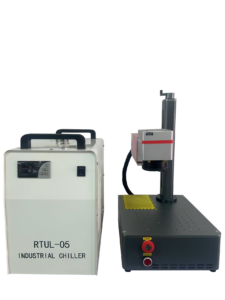
UV-1-1 sits in the same 355 nm engineering family as the UV T3 split-type 3/5/10 W, and that carries one non-negotiable requirement: water cooling. Frequency tripling from 1064 nm to 355 nm takes place in a temperature-sensitive crystal, and a drift of only ±0.5 °C changes beam stability, output and tube life. LAMBD therefore specifies a chiller that holds the crystal at 20–25 °C ±0.5 °C; typical chiller draw is around 1000 W, and the UV tube is rated for 20,000–30,000 hours. Allow 4–6 minutes for chiller warm-up, keep the water temperature above the dew point of the workshop to avoid condensation on optics, use only the recommended coolant and replace it on schedule, and place the chiller on a level surface with free airflow. Recipes are deliberately gentle. Glass: start at 40–70% power, 20–40 kHz, 300–700 mm/s, 1–2 passes. Medical and clear plastics: start at 20–50% power, 30–60 kHz, 500–1200 mm/s, 1 pass; silicone and soft PVC need a separate test because they deform and soil more easily. PCB, FPC, wafer and sapphire: keep passes to 1–2 and use the smallest practical field so the spot stays fine and energy density stays high. These are starting points, not a universal table: resin, color, filler, flame retardant, wall thickness, coating and polish all change the result, so LAMBD recommends a 30-second sample on the real part and a named EZCAD recipe before production. Also fit a HEPA + activated-carbon extractor for plastics and medical polymers — cold marking still produces fumes, and smoke on the F-theta lens changes focus and ruins repeatability.
Quality Control, Safety and Scaling From UV-1-1 to the LAMBD Line
A fine mark is only useful if it can be read and traced. After marking, check the code to ISO/IEC 15415 (2D) or ISO/IEC 15416 (linear): modules must be even, with no burns, bridges or missing cells, and the grade must meet the required level. Scan the part with several readers at different distances and angles, and record the first-read result as part of the technical file. For medical and pharmaceutical parts, add environmental and sterilization cycling, then re-scan — the point of cold marking is that the code survives without wall damage. Serialization is built into the workflow: LAMBD assigns a unique serial number, date, lot and expiry through EZCAD and variable data from Excel via CSV, then exports the log to MES/ERP — supporting DSCSA, EU FMD and Честный ЗНАК requirements. Safety is the one topic that is never optional: UV-1-1 uses a Class 4 open beam, so a basic enclosure, interlock and laser safety glasses are mandatory, and the operator must never look into the beam path, even at low power. Scaling is straightforward because the whole LAMBD range shares the same software and discipline: start ultra-fine work on a UV-1-1 mini, move to a UV T3 3/5/10 W split type for higher duty or a separated head, use fiber (T6 Mini, LM-11-3, LM-1-x, LM-9-2) for metal and hard-anodized plastic, and use CO₂ (CA2-1, CO₂-1-2, CO₂-3-4) for organics, cutting and signage. LAMBD warranty is 1 year on the machine and 2 years on the source, and remote recipe setup reduces commissioning time. For an English-site buyer the conclusion is direct: if the part punishes heat, choose 355 nm cold marking on UV-1-1, validate the recipe on a real sample, control the chiller and protect the operator — that is how a micro-mark becomes a reliable product feature rather than a production risk.
Summary: Ultra-Fine, Heat-Free Marking Begins at 355 nm
The LAMBD UV-1-1 mini is a 355 nm UV laser for ultra-fine, cold marking on materials that react badly to heat: glass and glass coatings, clear and colored plastics, thin-wall electronics, PCBs, FPCs, silicon wafers, sapphire, ampoules, vials, syringes, catheters and acrylic. It removes material photochemically in a layer of 0.1–1 µm, so it avoids the burns, cracks, warping, haze and wall thinning that 1064 nm fiber or 10.6 µm CO₂ can cause. The “mini” format means a small footprint and a separated optical head — ideal for R&D, labs, toolrooms, jewelry and low-to-medium volume — while the marking quality is the same cold mechanism used by the UV T3 split-type 3/5/10 W and can deliver a 0.01 mm line at ±0.001 mm repeatability where the application allows. The trade-off is deliberate: water cooling is mandatory, with the chiller holding the crystal at 20–25 °C ±0.5 °C, a typical draw of around 1000 W and a UV tube rated for 20,000–30,000 hours. Starting recipes are 40–70% power, 20–40 kHz, 300–700 mm/s, 1–2 passes for glass and 20–50% power, 30–60 kHz, 500–1200 mm/s, 1 pass for medical/clear plastics — both to be verified on a real sample and saved as a named EZCAD recipe. Quality control means ISO/IEC 15415 grading, multi-reader first-read checks, sterilization cycling and CSV-driven serialization into MES/ERP. For an English-site audience the takeaway is clear: when the part is transparent, thin-wall, electronic or medical, do not try to “finesse” it with fiber — choose the 355 nm cold mark on a LAMBD UV-1-1, and you get a permanent, readable, ultra-fine code without the heat defect.
Post time: 10-21-2026