Why Apparel and Footwear Are Moving From Ink, Woven Tags and Hot Stamping to Lasers
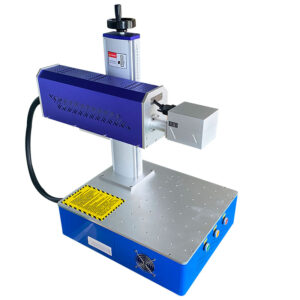
Traditional garment branding relies on woven care labels, screen-printed logos, rubber heel patches, and hot-foil stamping on leather — all of which add trim cost, chemical inks, adhesive waste, and a recycle-hostile layer that consumers increasingly hate scratching their skin. lambd laser marking removes the middle layer entirely: a focused beam physically alters the fabric, leather, or hang tag, leaving a permanent logo, size code, care symbol, or QR without thread, ink, or glue. For natural textiles the workhorse is the CO₂ wavelength 10.6 µm (lambd CA2-1 desktop or CO₂-1-2 split, 30–100 W, galvo speed up to 7000 mm/s, field 110×110 to 300×300 mm, air- or water-cooled, EZCAD + JCZ control), which vaporizes indigo on denim into high-contrast "cat whiskers" and bleaches cotton canvas without water or potassium permanganate. For genuine leather goods — shoes, belts, wallets — CO₂ at 10.6 µm is absorbed ~92 % by the organic hide, giving a clean darkened or debossed logo; on dark chrome-tanned hides a 20–30 W fiber at 1064 nm (lambd T6 Mini or LM-11-3) can drop a high-contrast annealed mark on metal-reinforced tags and eyelets. The result for a brand: one machine, zero consumables, and a mark that survives 50 wash cycles, salt, and abrasion.
CO₂ Laser on Fabric: Denim, Cotton, Fleece and Direct-to-Garment Care Codes
When a 10.6 µm CO₂ beam from a lambd CA2-1 hits cotton or denim, the pulse energy ablates the top dye and a few microns of fiber — no melting, just a permanent tonal shift from indigo to pale stone-wash, or from cream canvas to a sepia logo. On polyester and fleece the same beam melts and re-solidifies the synthetic fiber, sealing the edge so micro-perforations for sportswear ventilation never fray. Typical parameters: 30–60 W CO₂, 200–600 mm/s, 20–40 kHz, 110×110 mm field, F=160 lens; denim whiskers take 2–4 s per pair of jeans panels, cotton tote logos 1–2 s. Because the mark is the fabric itself, there is no label to itch, no print to crack, and recycling sorters no longer reject a blended shirt for a glued tag. lambd publishes direct-to-fabric workflows where care symbols (wash tub, iron, tumble), size S/M/L, fiber composition, and a unique QR for anti-counterfeit traceability are etched on the inner hem of t-shirts, the tongue underside of sneakers, and the lining of jackets — replacing the woven label entirely and cutting trim spend 30–60 % in mid-volume lines.
Leather Logos, Heel Tags and Serialized Hide Marking With CO₂ and Fiber
Footwear and leather goods live or die on brand feel: a crooked hot-stamp or a peeled rubber patch reads as "cheap". A lambd CO₂-1-2 split at 60 W and 10.6 µm darkens vegetable-tanned leather into a crisp 0.1 mm debossed logo on a wallet flap, belt tip, or shoe counter in 3–5 s, with no foil, no clamps, no post-clean. On finished calfskin a lower power 30 W CO₂ at 800 mm/s gives a tonal logo that preserves the grain. Where the product carries a metal rivet, zip pull, or steel shank tag, a lambd LM-11-3 30 W fiber at 1064 nm anneals a black serialized QR on that metal piece in 1.5 s — so the leather good and its hardware share one traceable ID. Luxury makers add a T6 Mini 20 W fiber bench for small leather charms and metal clasp logos. The hidden win is serialization: every shoe gets a unique QR tying to batch, tannery, and QC record, defeating counterfeit resellers who clone woven tags but cannot clone a laser-annealed code on the steel shank.
Hang Tags, Cardstock, Vegan Leather and the Zero-Label Sustainability Angle
A lambd CO₂ beam also cuts and marks the tag itself: kraft cardstock hang tags get a burned-edge logo and variable QR at 100–150 mm/s, 40 W, no inkjet cartridge, no die-cut label roll. Vegan leather (PU/PVC) is trickier — CO₂ melts PU cleanly at 10.6 µm but PVC needs lower power 20–30 W and fume extraction to avoid chlorine smell; alternatively a UV T3 5 W at 355 nm cold-marks PU without edge melt, ideal for white synthetic wallets. Brands chasing EU EPR and textile-to-textile recycling use laser etch instead of woven labels so the garment passes sorting without manual tag removal. lambd pairs CA2-1 for fabric and tags with T3 UV for synthetic-leather lines and LM-11-3 fiber for metal hardware, all under one EZCAD file format and one spare-part list — meaning a single operator runs fabric, leather, tag, and shank marking on one bench. The commercial angle: laser ID survives the resale market, supports NFT-linked product passports, and removes the $0.02–0.08 per-piece label cost that silently eats margin on 100k-unit runs.
Choosing the Right LAMBD Setup for a Garment or Footwear Line
Match wavelength to substrate, not to hype. Denim, cotton, canvas, fleece, leather, cardstock tags → CO₂ 10.6 µm, start with CA2-1 30–60 W desktop for batches <500/day or CO₂-1-2 split 100 W for roll-fed production. PU/PVC vegan leather with fine logos → UV 355 nm T3 5 W for cold mark, or 30 W CO₂ with extractor. Metal eyelets, shank tags, zip pulls, steel size studs → fiber 1064 nm, T6 Mini 20 W for bench customization or LM-11-3 30 W for line-side. Confirm galvo field (110×110 mm standard, 175×175 or 300×300 for large backpatches), EZCAD variable-data from Excel for QR+serial, and JCZ card stability. Power draw stays <0.5 kW on fiber, ~1 kW on CO₂, ~1 kW on UV; none use ink, ribbon, foil, or label stock. For a mid-size footwear brand doing 2000 pairs/day, a CO₂-1-2 100 W for uppers and insoles plus an LM-11-3 30 W for metal tags covers logos, care codes, size marks, and serialized QR under one lambd service contract and Russian/English EZCAD menu.
Summary: Laser Turns the Garment Itself Into the Label
Laser marking for apparel and footwear is no longer a niche finishing trick — it is the cleanest way to put a logo, care symbol, size code, and serialized QR on fabric, leather, hang tag, and metal hardware at once. lambd wraps the three relevant wavelengths into one workshop logic: CO₂ 10.6 µm (CA2-1, CO₂-1-2) for cotton, denim, fleece, leather and cardstock; UV 355 nm T3 for heat-sensitive PU/PVC; fiber 1064 nm (T6 Mini, LM-11-3) for metal eyelets, shanks and zip pulls — all EZCAD-driven, all zero-ink, all permanent through wash, wear and resale. Brands cut label trim 30–60 %, kill screen-print crack and hot-stamp peel, satisfy EU recycling rules by etching the care code on the hem, and beat counterfeiters with a laser-annealed QR on the steel shank that no woven tag can copy. For an English-site buyer comparing "laser vs woven label vs screen print", the answer is operational: lambd lets a garment line mark fabric, leather, tag and hardware from one software stack, one spare-part shelf, and a TCO that crosses below ink labeling inside 12–30 months.
Post time: 08-17-2026