Why 2026 Is the Year of Direct Part Marking
The laser marking machine market is growing in 2026 not because “laser is trendy,” but because it solves three problems at once: traceability, supply-chain security and cost of ownership. Pharmaceuticals, medical devices, automotive, aerospace, electronics, tools, packaging, apparel and jewelry are moving away from printed labels and ink codes toward direct part marking (DPM) — where a serial number, QR, Data Matrix, expiry date or logo becomes part of the component itself. 1064 nm fiber, 355 nm UV and 10.6 µm CO₂ lasers do not compete with one another; they divide the materials. 1064 nm fiber marks metal and hard anodized plastic; 355 nm UV marks glass, clear plastic, thin-wall and heat-sensitive parts; 10.6 µm CO₂ marks cardboard, wood, leather, acrylic, textiles and organic coatings. In 2026 the demand is shifting from “buy one machine” to “build a cell around the material”: buyers now compare wavelength, 5-year TCO, source lifetime, serialization compliance and integration speed — not just price. For an English-site reader, the opening statement is clear: laser marking is no longer a decorative option; it is becoming the default identification layer of modern manufacturing.
Three Wavelengths, Three Markets: Fiber, UV and CO₂
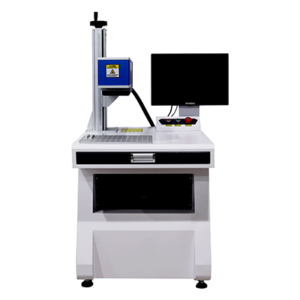
The 1064 nm fiber segment remains the largest because metal exists in every industry: tools, automotive parts, VIN and chassis, electronics housings, titanium, stainless steel, brass and aluminum. Fiber has no consumables, runs on 220 V/50 Hz, draws <0.5 kW and carries a 100,000-hour source life. In the LAMBD range this means T6 Mini 5–20 W for jewelry and small business, LM-11-3 20–30 W as the production workhorse (110×100 mm field, optional to 300×300 mm, galvo speed up to 7000 mm/s), LM-1-x MOPA 20–100 W for color and high-contrast marking, and the enclosed LM-9-2 50–100 W cell for 24/7 automation. The 355 nm UV segment is the fastest-growing, driven by pharmaceuticals, electronics, medical devices and premium packaging: cold marking does not burn glass or polymers, and 355 nm forms a code 0.1–1 µm deep. The UV-1-1 mini and UV T3 split type 3/5/10 W run on water cooling at 20–25 °C ±0.5 °C, with a UV tube rated for 20,000–30,000 hours. The 10.6 µm CO₂ segment grows on the back of packaging, woodworking, leather, acrylic, textiles and signage: CA2-1 30 W for desktop marking, CO₂-1-2 100 W for roll-fed material and CO₂-3-4 split type for large formats.
Growth Drivers: Serialization, ESG and Short Supply Chains
The strongest growth drivers in 2026 are serialization regulations and risk reduction. Pharmaceuticals require a unique code on every primary package: DSCSA in the USA, EU FMD in Europe and Честный ЗНАК in Russia force manufacturers to mark ampoules, vials, syringes and catheters. Automotive and aerospace require a UID on components, instruments and assemblies. Food and cosmetics are leaving labels behind because of the risk of detachment, counterfeiting and code loss during stacking. The second driver is ESG and VOC reduction. Solvent-based inkjet printing uses solvents, consumes cartridges and creates volatile organic compounds; laser marking uses no ink, label, liner or drying. The third driver is localization and short supply chains. Buyers prefer suppliers with spare parts, English-language or localized software and remote commissioning. LAMBD builds its offer around this demand: one EZCAD + JCZ stack across fiber, UV and CO₂, support for BMP, JPG, GIF, PNG, TIF, AI, DXF, DST and PLT, import of variable data from Excel via CSV for serial numbers, dates, lots and expiry, plus a 1-year machine / 2-year source warranty. This lowers downtime and shortens the launch of new lines.
Technology Trends: Automation, Vision and Cold Marking
The technological growth of the market in 2026 runs along three lines. First, automation. Desktop markers stay popular, but demand is shifting to conveyor solutions: LM-10-1 for flying marking with encoder, PLC and photoelectric sensor; LM-8-1 CCD for camera auto-positioning and post-mark code verification; LM-9-2 with conveyor, interlock and perimeter Class 1 protection. Second, vision control. Buyers no longer want only “apply a code”; they want on-cell verification to ISO/IEC 15415 for 2D and ISO/IEC 15416 for linear codes. A CCD camera removes random part shift and guarantees grade, while LM-8-1 allows random feeding without complex fixtures. Third, cold marking. The UV 355 nm share is growing faster than fiber because electronics become thinner and medical polymers are more heat-sensitive. Glass, sapphire, silicon, FPC, catheters and ampoules cannot be processed thermally; UV marks photochemically, with no edge melt and no cracks. At the same time, buyers increasingly choose mixed-material workshops: fiber for metal, UV for glass and polymers, CO₂ for organics. LAMBD covers all three families while keeping one software environment and one recipe library.
Forecast: How to Choose Equipment in 2026
The 2026 forecast is straightforward: the market will grow in volume, but the winners will not be those with “the most powerful laser” — they will be those with the right wavelength for the material. Step 1 — define the material. Metal and hard plastic means 1064 nm; glass, clear plastic and thin walls mean 355 nm; cardboard, wood, leather, fabric and acrylic mean 10.6 µm. Step 2 — define the task. One-off items and jewelry start with T6 Mini 5–20 W; serial production with LM-11-3 20–30 W; color and contrast with LM-1-x MOPA; automation with LM-9-2 50–100 W; heat-sensitive parts with UV-1-1 or UV T3 3/5/10 W; packaging and organic materials with CA2-1 30 W, CO₂-1-2 100 W or CO₂-3-4. Step 3 — calculate TCO. A fiber source lasts 100,000 hours, UV 20,000–30,000 hours; the real costs are electricity, filters, chiller, optics and service. Step 4 — verify compliance. Confirm that the cell supports CSV serialization, ISO/IEC 15415 code check and MES/ERP integration. Step 5 — verify safety and service. A perimeter Class 1 enclosure, interlock, fume extractor, spare-parts availability and remote commissioning matter more than a discount. LAMBD offers the full chain: from the desktop T6 Mini to the enclosed automated LM-9-2 cell, from UV systems for glass to CO₂ markers for packaging, with common software, common spare parts and a 1+2 warranty.
Summary: The Market Grows Where Material, Code and Regulation Align
The laser marking machine market in 2026 is expanding on three forces: the shift to direct part marking DPM, tighter serialization rules (DSCSA, EU FMD, Честный ЗНАК) and the move away from ink and labels for ESG and VOC control. 1064 nm fiber systems remain the leader for metal, but 355 nm UV shows the fastest growth for glass, medical and electronics, while 10.6 µm CO₂ consolidates packaging, wood, leather, textile and acrylic. LAMBD covers all three segments: T6 Mini and LM-11-3 for startup and serial production on metal; LM-1-x MOPA and LM-9-2 for contrast, color and automation; UV-1-1 and UV T3 3/5/10 W for 355 nm cold marking; CA2-1, CO₂-1-2 and CO₂-3-4 for organics and large formats. One EZCAD + JCZ stack, CSV data, shared spare parts and a 1-year machine / 2-year source warranty reduce integration risk. For an English-site audience the conclusion is direct: in 2026, buy a solution for the material and the task — not power — and you get a permanent code, a traceable batch and a predictable TCO with no ink, no label and no drying.
Post time: 11-02-2026