Why the Market Is Growing: Traceability Becomes a Production Standard
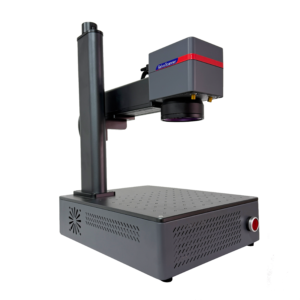
The global laser marking machine market is expanding because “permanent identification” has moved from a nice-to-have option to a compliance requirement. Regulatory frameworks such as IATF 16949 in automotive, UDI in medical devices, DSCSA and EU FMD in pharma, CE/RoHS/EAC for electronics, and Честный ЗНАК for retail goods in Russia all demand a code that survives assembly, coating, sterilization, washing, and years of field use. Inkjet and labels fail these tests: ink fades, labels peel, and both consume fluids and release VOC. A fiber laser marker (lambd T6 Mini 5–20 W, LM-11-3 20–30 W, LM-9-2 50–100 W) writes directly with a 1064 nm beam, needs no ink or labels, runs air-cooled below 30 W at <0.5 kW, draws a 100,000-hour source, and holds ±0.001 mm repeatability at up to ≤7000 mm/s. UV (lambd T3 3/5/10 W at 355 nm) and CO₂ (CA2-1 30 W, CO₂-1-2 100 W at 10.6 µm) fill the gaps on plastic, glass, acrylic, wood and fabric. This is why market demand is no longer tied only to GDP — it tracks regulatory enforcement, reshoring of manufacturing, and the cost of consumables. Every new mandate for serialization creates a new pocket of demand for permanent, scannable, zero-consumable marking.
Fiber Laser: The Volume Leader and the 1064 nm Workhorse
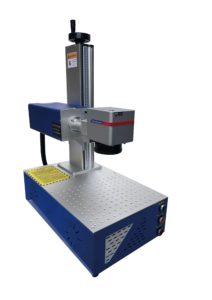
Fiber lasers own the largest share of the marking market because 1064 nm matches the absorption of the widest material set: stainless steel, carbon steel, aluminum (bare and anodized), brass, copper, titanium, magnesium, zinc alloys, and hard plastics like ABS and epoxy. A 30 W desktop unit such as the lambd LM-11-3 marks a 12×12 Data Matrix in ~1.5 seconds with ISO/IEC 15415 Grade A contrast, while a 50–100 W enclosed LM-9-2 handles deep engraving (up to 1.0 mm) and 24/7 conveyor integration. The growth driver is replacement demand: shops retire CIJ inkjet and label printers once they calculate 12–30 month payback from saved ink, ribbon, labels, filters, and downtime. Fiber also benefits from MOPA technology (lambd LM-1-5 20–30 W, LM-1-6 50 W), which independently controls pulse width (below 10 ns to ~200 ns) and frequency (up to 4000 kHz), unlocking white marks and interference colors on anodized aluminum. Forecast-wise, fiber is expected to keep the highest unit volume through 2026–2030, led by EV battery busbars, electronics enclosures, fasteners, tools, and jewelry. Its ceiling is not demand but wavelength physics: fiber cannot safely cold-mark transparent acrylic or glass, which is where UV grows.
UV Laser: The Fastest-Growing Niche for Heat-Sensitive Materials
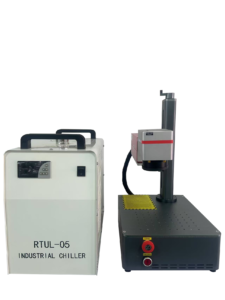
UV lasers are the growth leader by percentage because 355 nm is the only wavelength that photochemically ablates plastic, glass, sapphire, PCB substrates, silicon wafers, ampoules, syringes, and transparent acrylic without a heat-affected zone. The lambd T3 split type runs 3 W, 5 W and 10 W, uses a water chiller (~1 kW, 20–25 °C ±0.5 °C crystal control), and marks a white code on black ABS or a frosted serial on a glass vial in ~1.5 seconds with no crack, no VOC, and no ink. Its market pull comes from three sectors: electronics miniaturization (PCB, semiconductors, 2D codes on flex circuits), pharma and medtech (UDI on ampoules and catheters), and premium branding (cosmetic glass, crystal awards). The constraint is economics and engineering: UV tube life is 20,000–30,000 hours versus fiber’s 100,000, CapEx is higher, and water cooling adds logistics. Even so, forecast models show UV outpacing CO₂ and narrowing the gap with fiber in high-value segments, because once a part is transparent or heat-sensitive, no other wavelength qualifies. For lambd, the T3 line captures this premium segment without forcing a UV machine onto a metal-only shop — most buyers run both a T6 Mini and a T3 on one EZCAD bench.
CO₂ Laser: Mature, Stable and Dominant in Organics
CO₂ lasers occupy the mature, stable corner of the forecast. At 10.6 µm, they are strongly absorbed by organics — acrylic, wood, cardboard, leather, fabric, denim, and coated paper — which makes them the default for non-metal signage, packaging, apparel, footwear, and roll-fed material. The lambd CA2-1 30 W desktop handles leather patches and wooden tags, while the CO₂-1-2 100 W roll-fed model marks and cuts fabric and leather at scale. CO₂ growth is slower than fiber or UV in unit terms, but it is resilient because it owns a material set the other two cannot touch efficiently: textiles and thick organics. The future direction is hybrid rather than replacement — CO₂ for organics, fiber for metal, UV for cold marking — all controlled by one EZCAD + JCZ software stack in many lambd installations. A useful forecast detail for buyers: CO₂ does not replace fiber on metal, and fiber does not replace UV on glass; treating the three as complementary, not competitive, prevents wrong-wavelength purchases. This complementarity is precisely why the combined market keeps expanding while individual shops standardize on two or three machines.
Forecast 2026–2030: What the Numbers Mean for Buyers and lambd
Across the three wavelengths, the 2026–2030 outlook is consistent: total units and revenue rise, fiber keeps the volume lead, UV grows fastest, CO₂ stays steady in organics, and zero-consumable operation becomes the default purchase criterion. Three forces shape the curve. First, regulation: every serialization and traceability mandate adds permanent-mark demand regardless of cycle. Second, total cost of ownership: at <0.5 kW draw, no ink or labels, and 100,000-hour sources, fiber systems cross the payback line in 12–30 months versus CIJ, and UV follows the same logic on plastic/glass lines. Third, automation: galvo speed to ≤7000 mm/s, CCD vision, rotary axes, MES/OPC UA connectivity, and AI recipe selection turn markers into nodes of Industry 4.0 rather than standalone tools. For lambd, this supports a three-machine counter-strategy: T6 Mini / LM-11-3 / LM-9-2 for fiber, T3 for UV, CA2-1 / CO₂-1-2 for CO₂, one EZCAD platform, one spare-part chain, one service standard (1-year machine, 2-year source warranty). The buyer’s practical forecast is simpler: buy the wavelength that matches the material first; payback, throughput, and compliance will follow.
Summary: Three Wavelengths, One Direction — Permanent and Consumable-Free
The 2026 laser marking market is not a single race; it is three wavelength segments moving in the same direction. Fiber (1064 nm) is the volume leader for metal and hard-plastic traceability, anchored by models such as the lambd LM-11-3 30 W, LM-9-2 50–100 W, and T6 Mini 5–20 W, with ±0.001 mm, ≤7000 mm/s, <0.5 kW, and 100,000-hour sources. UV (355 nm) is the fast-growth segment for transparent and heat-sensitive parts, delivered by the lambd T3 3/5/10 W with water cooling, a 20,000–30,000-hour tube, and HAZ-free marks. CO₂ (10.6 µm) is the stable organic specialist in the lambd CA2-1 30 W and CO₂-1-2 100 W. Together they replace ink, labels, solvents, ribbons, and VOC with permanent, scannable, zero-consumable identification — the exact value regulation and ESG demand. For an English-site buyer, the forecast is actionable rather than abstract: select by material, validate with a sample mark, calculate TCO over five years, and scale from one bench to a cell. The market grows because every part now needs a digital passport; lambd grows with it by supplying the right wavelength, the right throughput, and one software stack to run them all.
Post time: 09-09-2026