Why 1064 nm Fiber Is the Right Tool for High-Reflective Light Metals
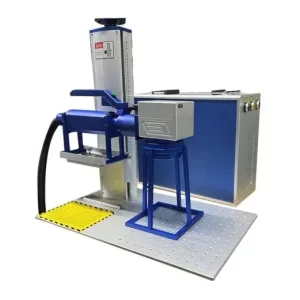
Magnesium alloys (AZ31B, AZ91D) and zinc alloys (ZAMAK-3, ZAMAK-5, ZnAl4Cu1) are not "unmarkable" metals — they are simply high-reflective light alloys that punish sloppy parameters. At 1064 nm a polished AZ31B surface reflects roughly 82–94% of the incident beam, SiC-ground magnesium drops to about 73%, and a marker-pen-blackened surface pushes absorption near 49%; die-cast zinc sits in the 70–85% reflection band depending on skin oxide and release-agent residue. A lambd fiber marker (T6 Mini 20 W, LM-11-3 30 W, LM-9-2 50–100 W) emits 1064 nm from a ytterbium-doped fiber, focuses it through an F-theta lens to a 30–50 µm spot, holds ±0.001 mm repeatability, scans up to 7000 mm/s, draws under 0.5 kW air-cooled up to 30 W, and runs a 100,000-hour source. The trick on Mg and Zn is not brute power but a short, high-peak MOPA pulse (<10 ns) that cracks the reflection threshold, seeds a micro-plasma, and precipitates an MgO or ZnO oxide film — that film is the contrast. So bare magnesium is marked like aggressive aluminum, and zinc like brass with the power rolled back.
Magnesium Alloys: Dark Oxide Annealing Without Ignition
Magnesium ignites in casting and welding, but during 1064 nm short-pulse marking the heat stays in a 0.1–1 µm surface layer and never reaches the combustion point. On AZ31B, a lambd LM-11-3 30 W MOPA runs 30–50% power, 40–80 kHz, 400–800 mm/s, 1–2 passes, 0.03 mm hatch and lays a uniform dark-grey mark; literature on nanosecond 1064 nm Nd:YAG over AZ31B shows "cauliflower" oxide clusters and even darkening at high peak power. For a black Data Matrix on a milled AZ91D laptop cover, push frequency to 60–100 kHz, drop speed to 300 mm/s — contrast climbs, but keep peak fluence in check or the edge blooms white. Always degrease with acetone or isopropanol, never mark straight off the casting line with emulsion still on, and proof on a scrap of the same alloy. A 20 W T6 Mini air-cooled unit handles one-off magnesium eyewear frames; for 500+ parts per shift move to LM-11-3 or enclosed LM-9-2 with fume extraction.
Zinc Alloys and ZAMAK: Soft Melt, Low Power, High Contrast
Die-cast zinc (ZAMAK-3/5, ZnAl4Cu1) is softer than steel and aluminum and melts near 420 °C, so fiber marks it beautifully — but overshoot power and you get molten edges and "orange-peel" texture. On ZAMAK-5, a lambd T6 Mini 20 W fires 15–25% power, 30–60 kHz, 600–1200 mm/s, 1 pass for a grey-to-dark-grey serial and logo with zero remelt. For 0.05–0.1 mm depth on a cast handle, raise to 40–50% and 3–5 passes at 400 mm/s. Casting skin matters: fresh ZAMAK reflects more, light bead-blast or passivation etch lifts absorption and stabilizes the mark. MOPA on LM-11-3 tunes pulse width independently — <10 ns gives a clean grey code, 100–200 ns gives micro-ablation ready for paint. Zinc furniture hardware, locks, toy mechanisms, and electronics enclosures are the classic case where 20 W fiber beats 30 W on steel for accuracy.
MOPA Pulse, Rotary Axis, and EZCAD Recipes for Two Alloys
There is no universal preset for Mg and Zn — the rescue is JCZ + EZCAD and a recipe table. For AZ31B save "Mg_anneal_30W": 30% power, 60 kHz, 500 mm/s, 2 passes, 0.025 mm hatch, PWM 6. For ZAMAK-5 save "Zn_surface_20W": 20% power, 45 kHz, 900 mm/s, 1 pass, 0.03 mm hatch, PWM 4. On cylindrical parts (zinc lock shaft, magnesium tube) plug in the rotary axis: EZCAD syncs galvo and rotor so the mark wraps 360° with no clamp scar. MOPA pulse width solves the reflection problem — short pulse on magnesium avoids heating to ignition, short pulse on zinc avoids edge melt. Keep a log: alloy, surface state (cast/milled/chromated — magnesium is sometimes chromated), power, frequency, speed, passes, scan grade; otherwise a shift change burns a batch. lambd keeps T6 Mini, LM-11-3, and LM-9-2 on one software stack, so a recipe ported from a 20 W bench to a 100 W enclosed cell needs no re-tuning.
Why 1064 nm Fiber, Not UV and Not CO₂, on Mg and Zn
A 10.6 µm CO₂ beam reflects off both alloys above 85% — you need marking spray, and the result is chemical, not permanent. A 355 nm UV can physically mark, but on metal it wastes 10–15% of doubling efficiency as crystal heat, costs 2–3× the CapEx, and delivers no better contrast on magnesium or zinc than 1064 nm MOPA. The 1064 nm fiber is the only option where bare magnesium absorption (even 10–20%) under a short pulse is enough for an oxide mark, and zinc absorption (15–25%) yields a grey code in one pass. lambd packages this as air-cooled T6 Mini 20 W for magnesium spectacle frames and zinc key fobs, bench LM-11-3 30 W for hardware batches, and enclosed LM-9-2 50–100 W for 24/7 cell marking — all 1064 nm, all JCZ + EZCAD, all ±0.001 mm, all ink-free. The buyer searching "laser for magnesium and zinc alloys" should not hear "highest watt", but "20–30 W MOPA 1064 nm with per-alloy recipes".
Summary: Magnesium and Zinc Mark Well With Fiber — If You Respect the Parameters
Laser marking magnesium alloys (AZ31B, AZ91D) and zinc alloys (ZAMAK, ZnAlCu) with a 1064 nm fiber works because a short high-peak MOPA pulse beats reflection, deposits an MgO/ZnO film, and leaves a permanent grey or dark code — annealing adds no material loss, micro-ablation adds depth. lambd T6 Mini 20 W, LM-11-3 30 W, and LM-9-2 50–100 W cover the whole range from a single magnesium ring blank to a million-piece ZAMAK hardware run: 1064 nm, ±0.001 mm, 0.01 mm line width, ≤7000 mm/s, JCZ + EZCAD, 100,000-hour source, air cooling to 30 W. The rule is never copy steel presets — magnesium likes 30–50% power, 40–100 kHz, 300–800 mm/s and extraction; zinc likes 15–25% power, 30–60 kHz, 600–1200 mm/s and light surface prep. For an English-site buyer the takeaway is operational: magnesium and zinc are not exceptions to the fiber rule, they are a discipline test, and lambd passes that test with the mark still scannable.
Post time: 08-26-2026