Why Total Cost of Ownership Beats the Sticker Price
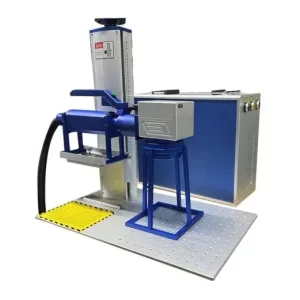
When a plant manager compares a lambd fiber laser marker with a CIJ (continuous inkjet) printer for a metal line, the first number on the table is always the wrong one: CapEx. A CIJ unit looks cheap at $3,000–8,000, while a 30 W desktop fiber marker such as the lambd LM-11-3 or a T6 Mini 20 W sits at a higher upfront number. But the purchase price is only the start of the cash flow. TCO — total cost of ownership — adds every recurring expense over five years: ink and makeup fluid, solvent, filters, printheads, nozzles, labels, ribbon, release liner, compressed air, maintenance visits, downtime, and the labour to swap consumables. On a metal line, the laser has no ink, no solvent, no printhead, no labels, no ribbon, and no chemical etchant; it is a zero-consumable process. The beam comes from a 1064 nm ytterbium-doped fiber, is steered by a galvo, and writes directly onto steel, aluminum (bare and anodized), brass, copper, titanium, magnesium and zinc alloys. Standard 20–30 W units draw <0.5 kW from a 220 V/50 Hz single-phase supply, run air-cooled, and carry a 100,000-hour source rating. EZCAD (JCZ board) handles BMP, JPG, GIF, PNG, TIF, AI, DXF, DST and PLT, including variable data from Excel via CSV. Once you model the next five years instead of the next invoice, the "expensive" laser becomes the cheap machine.
The Five-Year Math: Recurring Cost Is Where CIJ Collapses
Let us build a realistic five-year model for one shift (8 h/day, 300 days/year). CIJ recurring cost: ink and makeup fluid roughly $2,000–4,000/year, solvent and cleaning $500–1,000/year, filters and consumables $300–600/year, plus periodic printhead/nozzle replacement ($500–1,500 every 1–2 years) and a service contract ($1,000–2,000/year). That totals $4,000–8,000 per year, or $20,000–40,000 over five years — and this assumes no price increase, no spill, and no major line stop. Label or ribbon users add another $0.01–0.05 per piece for serialized tags, which on a 500-piece/day line is $3,750–18,750/year on top. Now the fiber: electricity is ~0.5 kW × 8 h × 300 days ≈ $120–240/year at US commercial rates; consumables are isopropyl and lens tissue (< $100/year); maintenance is occasional galvo/lens checks; the source is rated 100,000 hours (far beyond five years). Total five-year recurring cost is roughly $1,500–3,500 — about 10–15× lower than CIJ. Even after paying the higher CapEx, the curves cross at roughly 12–30 months, and years 3–5 are nearly pure savings. A two-shift line doubles CIJ recurring cost but adds almost nothing to the fiber, pulling payback even earlier.
Throughput and Uptime: The Hidden Lines on the TCO Sheet
TCO is not only money; it is parts per hour and minutes of downtime. A CIJ prints fast in short text, but it needs warm-up, purge cycles, nozzle wiping, ink viscosity checks and periodic full teardowns — typical unplanned downtime runs 2–8 hours per month. A clogged nozzle means rework: a smeared code fails the scanner, the part gets relabeled or scrapped, and traceability data drifts. A lambd fiber marker has no nozzle and no ink path. Marking speed reaches ≤7000 mm/s on the galvo; a 12×12 Data Matrix (ISO/IEC 15415 Grade A) lands on stainless in ~1.5 seconds at 30 W, 50 % power, 60 kHz and ~600 mm/s with a 0.02 mm hatch. A serial + QR on a 6061 bracket (30–50 % power, 40 kHz, 500 mm/s, 2 passes) takes 3–5 seconds per part. On an LM-9-2 50–100 W enclosed cell, a CCD camera auto-positions the part, the recipe is recalled from EZCAD, and a single operator runs the loop. Because there is no drying time and no ribbon change, throughput is limited only by handling time, not dwell time — so a 6-second cycle (2 s mark + 4 s load/unload) yields 600 parts/hour and 4,800 parts/8-hour shift. Over five years, that extra uptime and the avoided rework often exceed the consumable savings in dollar terms.
Quality, Compliance and the Cost of a Bad Mark
A bad mark has a price that never appears on the consumables invoice. CIJ contrast drifts as nozzles age and ink viscosity changes, so a code that scans today may fail tomorrow; labels peel in washdown, autoclave or outdoor use; ribbons fade. On stainless, a lambd fiber marker can anneal at 60–80 kHz and 800–1500 mm/s, producing a black UDI code with zero material removal — corrosion resistance and surface profile survive 100+ autoclave cycles, which matters for UDI compliance. On anodized aluminum, a single pass at 20–30 % power, 40 kHz, 1500 mm/s gives a clean white or black logo without stripping the anodic layer; on bare 6061, 30–50 % power, 40–60 kHz, 500–800 mm/s, 2 passes yields grey Al₂O₃ micro-dots. On magnesium AZ31B and ZAMAK zinc, the same logic applies: an oxide mark with no pigment, immune to plating or powder coat. Contrast stays at 99.8 %+ readability under ISO/IEC 15415 when the recipe is locked in EZCAD. For IATF 16949, UDI, CE, RoHS, EAC and Честный ЗНАК programs, a permanent, scannable mark with no label to peel and no ink to smear is an audit advantage — and it removes the risk of a recall triggered by an unreadable traceability code. That risk avoidance belongs on the TCO sheet.
The Verdict: A Worked Example and When CIJ Still Wins
Take a worked example: a two-shift metal parts line, 500,000 parts/year, choosing between a $5,000 CIJ and a $18,000 30 W lambd LM-11-3. CIJ five-year recurring cost ≈ $4,000–8,000/year × 5 = $20,000–40,000, plus the $5,000 machine and say $3,000 in downtime/rework — $28,000–48,000 all-in. The fiber: $18,000 CapEx + ~$2,000 recurring + ~$1,000 maintenance − $4,000 utility over five years ≈ $17,000–19,000 all-in. The laser saves ~$11,000–30,000 in five years, and the gap widens with volume and shifts. Warranty supports the case: 1-year machine / 2-year source from lambd, shared spare parts (lens, galvo, source, chiller pump on UV), and one EZCAD + JCZ stack across the range. CIJ still wins only in three narrow cases: (1) ultra-low CapEx on a short pilot with <12 months horizon, (2) highly porous or curved substrates where ink wets but laser has no absorption, and (3) coding on cardboard, film or flexible packaging where CIJ/TIJ is genuinely faster and cheaper. For metal nameplates, automotive Tier suppliers, EV busbars, tools, fasteners, medical devices and jewelry, the answer is fiber. The five-year TCO is not close — it is the single strongest argument for switching.
Summary: Over Five Years, the Laser Is the Low-Cost Machine
The five-year TCO comparison for metal lines is decisive: a CIJ inkjet line spends $20,000–40,000 over five years on ink, makeup fluid, solvent, filters, printheads, nozzles, labels, ribbon, service and downtime, while a lambd fiber marker (T6 Mini 5–20 W, LM-11-3 20–30 W, LM-9-2 50–100 W) spends roughly $1,500–3,500 on electricity and the occasional lens tissue — a 10–15× difference. Payback typically arrives in 12–30 months, after which years 3–5 are nearly pure savings, especially on two-shift and high-volume cells. The laser also removes the quality and compliance cost of unreadable codes: no nozzles to clog, no labels to peel, no ink to smear, and 99.8 %+ code readability locked into EZCAD recipes that survive plating, powder coat, sterilization and 100,000 hours of production. CIJ remains the right tool for short pilots and porous/flexible packaging, but for permanent marking on steel, aluminum, brass, copper, titanium, magnesium and zinc, the numbers favor fiber every time. For an English-site buyer, the conclusion is operational: do not compare the sticker prices — compare the five-year TCO. With lambd, the higher upfront number becomes lower total cost, higher uptime, and a traceability mark that is part of the metal itself.
Post time: 09-20-2026