355 nm Photon Energy: Why Cold Ablation Breaks Bonds, Not Heats Surface
The lambd UV T3 5W emits 355 nm from a frequency-tripled Nd:YVO₄ source — a photon at 355 nm carries ~3.5 eV, enough to snap C–C and Si–O bonds directly instead of dumping energy as heat like a 1064 nm fiber (1.17 eV) or 10.6 µm CO₂. This is "cold marking": the beam photochemically dissociates the top 0.1–1 µm of plastic or glass, the material goes solid-to-vapor with a heat-affected zone <1 µm, and the surrounding substrate never crosses its softening point. On the T3, the 5 W UV beam passes a 355 nm-coated F-theta lens, focuses to a 0.01 mm line width on a 100×100 mm or 150×150 mm field, scans at ≤7000 mm/s under a JCZ galvo, repeats at ±0.001 mm, and is held at 20–25 °C by a bundled water chiller (~1000 W from 220 V/50 Hz). Because 355 nm is absorbed by ABS, PC, PVC, PET, transparent acrylic and borosilicate glass far better than IR, the mark lands in a micron-thin layer — no melt rim, no yellow halo, no micro-fracture ring that a thermal laser leaves on glass.
Plastic Without Melt: ABS, PC, PVC, PET and Transparent Acrylic
Run the T3 5W on white ABS at 5 W, 20–40 kHz, 300–800 mm/s, 1 pass and you get a crisp grey or black logo with zero edge bubble; push a 1064 nm fiber at the same job and the surface browns, warps and smells of burnt polymer. Transparent acrylic and PC are where UV wins outright: 1064 nm slides through, 10.6 µm CO₂ frosts but risks crazing on thin sheet, while 355 nm cold-ablates a 2×2 mm QR with 30–40 dB scanner contrast and no stress line. PVC and PP food lids mark clean under UV with proper exhaust (PVC off-gasses chloride, so lambd ships the T3 cell with a fume port). Cosmetic cap makers use T3 5W to drop a batch code on glossy PE bottles at 600 mm/s, 1 pass, 0.2 mm text — the code survives perfume oil, alcohol wipe and shelf UV for 3+ years. Minimum character 0.1 mm, minimum line 0.01 mm means a 4-digit expiry on a 3 mm syringe barrel is routine.
Glass Without Crack: Perfume Vials, Pharma Ampoules, Borosilicate
Glass cracks under thermal lasers because the surface heats 200–400 °C in microseconds and tensile stress opens a fissure; 355 nm avoids that path entirely — it couples into a sub-micron skin, micro-fractures it in a controlled frost, and the bulk stays at room temperature. On a 5 ml perfume vial, lambd T3 5W at 3–5 W, 40–80 kHz, 400–900 mm/s lays a white serial + lot code in ~1.5 s, readable after filling, capping and 80 °C shrink tunnel. Pharma ampoules and diagnostic glass capillaries get a 1.5×1.5 mm Data Matrix for UDI, scannable through residual ethanol. Borosilicate drinkware and crystal awards take a 0.3 mm deep etched monogram without rim chips. Because there is no HAZ, the mark resists wiping with acetone and survives dishwasher cycles — the exact reason European pharma and perfume OEMs specify UV, not fiber, for glass SKUs.
T3 5W vs Fiber 10W vs CO₂ 30W on the Same Plastic-Glass Mix
Put a white ABS box, a clear acrylic tag and a glass vial on three benches. Fiber 10W (T6 Mini): steel ring inside 25 s, but on the ABS box it browns the edge at 30 % power, on acrylic it barely contrasts, on glass it does nothing. CO₂ 30W (CA2-1): acrylic frosts nicely, glass vial cracks on second pass, ABS melts the logo corner. T3 5W: ABS grey code 1 pass, acrylic high-contrast white QR 1 pass, glass vial white serial 1 pass — same EZCAD file, same JCZ board, three materials, zero reject. The trade-off is throughput and CapEx: UV 5W is slower than 10W fiber on metal and the source life is ~30,000 h vs fiber's 100,000 h, chiller adds ~15 kg and ~1000 W draw. But for a shop where >60 % of SKUs are plastic shells, glass bottles and clear acrylic — electronics enclosures, cosmetic OEM, labware — the T3 5W pays back precisely because it removes the scrap rate that thermal lasers invent.
Workshop Reality: Water Chiller, EZCAD Recipes, Zero Ink, 90-Day Payback
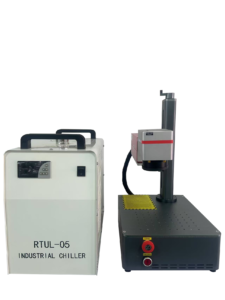
The T3 5W is not a toy UV pen — it is a bench system: source head + separate water chiller ~15 kg total, 220 V/50 Hz, JCZ EZCAD in English/Russian/Chinese, imports AI/DXF/BMP/PLT, variable data from Excel for lot+date+serial, red-focus pointer, optional rotary for vial curves. Daily start = switch on chiller, wait 4–6 min for crystal to hit 22 °C, fire. No ink, no solvent, no foil, no mask — a cosmetic brand marking 500 bottles/day kills the $0.015 pad-print tag and the alcohol-wipe complaint in week one. lambd stocks the UV tube, F-theta, galvo and chiller pump as spare parts on the same logistics as LM-11-3 and T6 Mini, so a mixed-wavelength bench (fiber for metal + T3 UV for plastic/glass) runs on one operator, one software, one service phone. For any English-site buyer filtering "laser for plastic and glass without cracking", the answer is a number and a model: 355 nm, lambd T3 5W.
Summary: Cold Is Not a Feature, It Is the Only Way Glass and Heat-Sensitive Plastic Survive
UV T3 5W at 355 nm marks plastic and glass by photochemical bond breaking, not heat — that single physics fact is why ABS stays unburnt, transparent acrylic gets a scannable QR, PVC lids stay flat, perfume vials carry a white lot code, and pharma ampoules take a UDI matrix without a crack ring. lambd packages this into a 5 W desk system: 0.01 mm line, ±0.001 mm repeat, ≤7000 mm/s, 100×100/150×150 mm field, JCZ+EZCAD, water chiller holding 20–25 °C, ~1000 W draw, ~30,000 h UV source life, zero consumable. Next to a 10W fiber it is slower on steel; next to a 30W CO₂ it is harmless on thin glass. For labs, cosmetic OEMs, electronics enclosures and promotional glassware the buying question is not "how many watts" but "what wavelength" — and on plastic-and-glass SKUs the wavelength is 355 nm and the machine is the lambd T3 5W.
Post time: 08-24-2026