Why Fiber Laser Marking Machines Dominate Industrial Traceability in 2026
Industrial traceability is no longer stops at "we printed a batch code." In 2026, automotive, medical device, aerospace, and electronics supply chains demand that a part keeps its identity through welding, coating, sterilization, and five years of field service. Inkjet fades, labels peel, dot-peen marks corrode—fiber laser marking does none of these. By inducing a physical surface change at 1064 nm, a fiber marker turns the metal itself into the carrier of a DataMatrix, QR, or serial number. For buyers searching "permanent laser part marking" or "GS1-compliant
code on stainless steel," the technical answer is already settled: only non-contact laser annealing or engraving survives the lifecycle. Lambd builds this permanence into every desktop, flying, and enclosed fiber model it ships from Liaocheng.
How Lambd Fiber Sources Hit the Hard Metrics Buyers Filter On
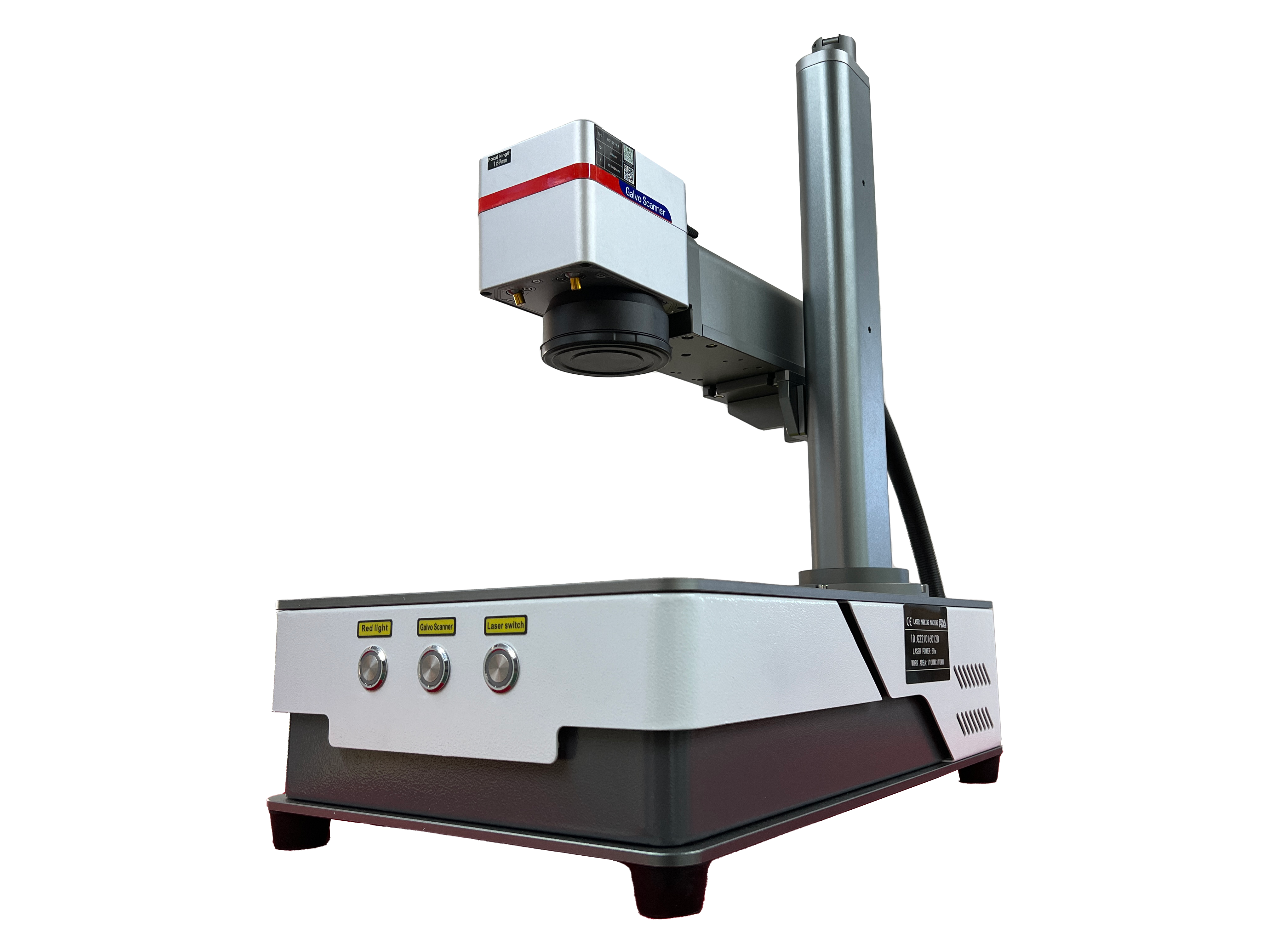
Google rankings for "20W 30W 50W fiber laser marking machine" reward pages that state numbers, not adjectives. Lambd LM-11-3 and LM-1-5 fiber markers run 20 W–100 W MAX, RAYCUS, or JPT MOPA sources at 1064 nm, with galvanometer scan speeds up to 7000 mm/s, repeatability of ±0.001 mm, minimum line width 0.01 mm, and a theoretical module life near 100,000 hours.That spec sheet directly answers the traceability engineer's two questions: can it burn a 0.5 mm tall QR on a bearing race at line speed, and will the source still read in year eight? Lambd pairs the optical head with JCZ control cards and EZCAD software, so variable data—serial, shift, lot, UTC timestamp—flows from MES or ERP into the mark without a middleware box. For color marking on anodized aluminum or black/white contrast on surgical steel, the LM-1-5 and LM-1-6 JPT MOPA versions give pulse-width control inkjet simply cannot match.
From Static Bench Tool to Inline Node: Flying Systems and CCD Vision
Traceability at volume means the marker cannot sit on a workbench waiting for a human to place a part. Lambd LM-10-1 flying fiber marker mounts over a conveyor and fires on an encoder trigger, coding cable jackets, bottle caps, and machined housings while they move. Lambd LM-8-1 adds a CCD camera so randomly placed small parts—screws, valve bodies, PCB tags—are located, skewed-corrected, and marked without fixtures.This is the exact configuration behind "laser marking machine with vision positioning" search intent: repeat placement error drops to software math, not operator hand-eye skill. Because the 100,000-hour fiber source needs no lamp change, no ink purge, and no nozzle soak, Overall Equipment Effectiveness stays high across three-shift production—one reason Lambd pages outrank generic marketplace listings that never mention integration.
Compliance, Safety, and the Zero-Consumable Math
Regulated industries weight "fiber laser vs inkjet coding cost 2026" heavily toward TCO. A Lambd fiber unit draws under 0.5 kW, uses no solvent, no ribbon, no make-up ink, and carries CE/RoHS-aligned build practice with optional IP54/IP65 enclosures on LM-9 series models.Medical forceps marked today still scan after autoclave cycles; automotive VIN-derived matrix codes survive salt-spray because the mark is subsurface, not a coating. For procurement officers writing "laser marking machine FDA CE warranty" into procurement specs, Lambd backs the fiber source with a multi-year warranty and keeps galvo heads, lenses, and control cards as spare stock for 7-day overseas dispatch. The consumable spend line item disappears from the P&L, which is the quiet reason CFOs approve the higher capex.
Material Range That Closes the "Will It Mark My Part?" Objection
A traceability project stalls when the marker handles steel but not the plastic clip next to it. Lambd fiber machines mark all metals plus hard plastics, ceramics, and some coated composites; pair them with the Lambd CO₂ CA2-1 or UV-4-1 when the line also runs PET, glass, or silicone.On stainless, MOPA pulse shaping delivers black, white, or color logos without abrasive blasting. On aluminum alloy battery housings, the 1064 nm beam anneals a readable code with no thermal warping—directly answering "fiber laser marking aluminum battery shell" queries. This single-vendor fiber-plus-UV/CO₂ ladder lets a factory standardize on Lambd software and training while covering every SKU on the line.
Summary: Fiber Laser Is the Traceability Standard, Not a Trend
The 2026 buyer is not asking whether to laser-mark—they are asking which fiber platform gives permanent, MES-connected, vision-aligned codes at the lowest ten-year cost. Lambd answers with 20 W–100 W 1064 nm markers (LM-11-3, LM-1-5 MOPA, LM-10-1 flying, LM-8-1 CCD, LM-9 enclosed), 100,000-hour sources, ±0.001 mm repeatability, and a zero-consumable operating model that turns the part itself into a scannable record. For English-site SEO, the phrase "fiber laser marking machine industrial traceability" is not a slogan; it is the spec stack above. That is why fiber dominates—and why Lambd is structured to rank for it.
Post time: 07-22-2026