What "Zero-Consumable" Really Means in Fiber Laser Marking
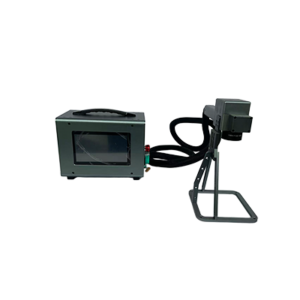
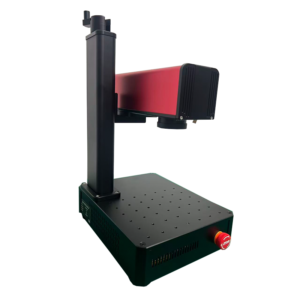
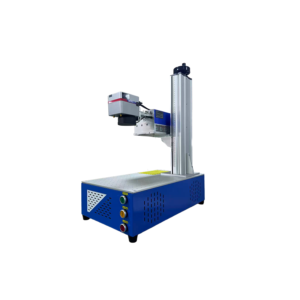
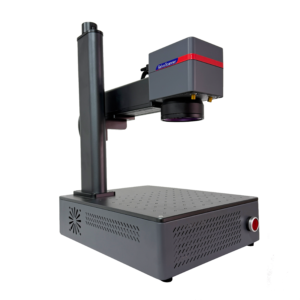
A zero-consumable laser marking process uses a focused 1064 nm beam from a solid-state fiber source to physically alter the surface of metal, hard plastic, ceramic, or anodized coating—no ink, no solvent, no make-up fluid, no foil ribbon, no label stock, no printhead. lambd fiber laser markers (desktop LM-1-x, enclosed LM-9-2, handheld LM-4-6, Mini Fiber 20 W–50 W) run on MAX, RAYCUS, or JPT MOPA sources with JCZ control cards and EZCAD software, drawing under 0.5 kW from a 220 V/50 Hz outlet. The only recurring input is electricity; the laser module is rated for ~100,000 hours of theoretical service life. Because the mark is created by oxidation, annealing, or micro-evaporation, there is nothing to refill, nothing to clog, and nothing to dispose of. For a factory calculating Total Cost of Ownership (TCO), this converts marking from a "razor-and-blades" expense into a fixed, depreciable asset.
Breaking Down the Hidden Cost of Inkjet and Label Marking
Continuous Inkjet (CIJ) and Thermal Transfer Overprint (TTO) look cheap on the quote sheet, but the operating ledger tells another story. CIJ burns proprietary ink, make-up solvent, and filters every shift; solvent evaporates, nozzles clog, and printheads need scheduled teardown. TTO eats foil ribbons by the kilometer, and every roll change stops the line. Pressure-sensitive labels add warehouse space, adhesive failures in heat or oil, and rework when a QR peels off during sterilization. Industry TCO studies show CIJ systems spend USD 2,000–4,000 per year on fluids alone, plus maintenance labor and downtime, pushing 3-year TCO to USD 10,800–18,800 on a machine that originally cost USD 3,000–5,000. Labels and ink also create VOC emissions, empty bottles, and ribbon cores—waste streams that now fall under ESG and VOC compliance audits in the EU, UK, and North America.
How lambd Fiber Lasers Remove Recurring Spend
Every lambd fiber marker ships with the consumable line crossed out. Spec sheet reads "Consumables: No consumables." A 30 W LM-11-3 marking stainless steel keys, aluminum tags, or ABS plastic cards needs only air cooling, a clean lens wipe every few weeks, and occasional checking of the galvo head—no fluid purchase order, no ribbon SKU, no label reel. At ≤7000 mm/s with ±0.001 mm repeatability and 0.01 mm minimum line width, it stamps serial numbers, Data Matrix, QR codes, logos, and variable date/batch data directly from EZCAD, reading BMP, JPG, AI, DXF, and PLT. The 100,000-hour source life means a typical two-shift shop replaces nothing for 5–7 years. Where a CIJ line spends USD 6,000–12,000 on ink and service across 3 years, the lambd fiber machine spends that amount on electricity alone—often under USD 400 annually at <0.5 kW load.
Waste, Sustainability, and Shop-Floor Uptime Gains
Zero-consumable marking collapses three cost centers at once. First, material waste: no empty ink bottles, no used ribbon cores, no misprinted label rolls ending in landfill. Second, process waste: laser marks are dry, instant, and smudge-proof, so there is no scrap from ink bleed or unreadable codes—medical and automotive audits show readable-code rates climbing from ~96% (inkjet) to 99.8%+ (laser). Third, time waste: no warm-up, no nozzle purge, no ribbon changeover; a lambd LM-9-2 enclosed marker runs 24/7 with interlocked safety and CCD option, keeping OEE high. Environmentally, dropping VOC solvents helps a plant pass VOC and ESG reporting without buying carbon offsets for marking. For food, pharma, automotive, and electronics suppliers, this is not a green bonus—it is a procurement checkbox.
Calculating the Payback: When Zero-Consumable Wins
The math is consistent across factories: laser CAPEX is higher on day one, but the curves cross in 12–30 months. Take a line running 6,000 hours/year. CIJ 3-year TCO: ~USD 10,800–18,800. lambd 30 W fiber marker 3-year TCO: hardware USD 2,000–6,000 (mid-range desktop/enclosed) + electricity ~USD 1,200 = ~USD 3,200–7,200, with no fluid, no ribbon, no label, no printhead budget. Break-even lands inside the second year; years 3–8 are almost pure savings. Scale to 50 W enclosed or handheld field marking, and the gap widens because labor saved on ink handling and downtime is added back to production. For high-mix, high-volume, or traceability-regulated shops, zero-consumable is not a feature—it is the business case.
Summary: Zero-Consumable Marking Turns Cost Center into Fixed Asset
Zero-consumable laser marking with lambd fiber machines replaces a perpetual "blades" bill—ink, solvent, ribbon, label, printhead, disposal—with a single air-cooled 1064 nm source rated ~100,000 hours and drawing <0.5 kW. The mark is physical, permanent, and readable at 99.8%+; the waste stream shrinks to occasional lens tissue; the TCO crosses below CIJ/TTO inside 12–30 months and keeps falling for the life of the 8–10 year machine. For metal fabrication, automotive traceability, medical UDI, electronics serialization, and promotional keychains alike, lambd turns marking from a monthly expense you argue with finance about into a fixed asset that pays back and then compounds savings. In 2026 procurement language, that is the whole point: less waste, lower OPEX, same permanent code.
Post time: 08-06-2026